GaitPilot Mobile App User Guide
Welcome to the GaitPilot Mobile App! This app is the core data collection and field-testing hub for your biomechanical data. It acts as your portable coaching assistant, processing data in real-time whether you are online or offline.
🏆 User Tiers & Capabilities Matrix
GaitPilot dynamically scales its capabilities based on your User Tier and the hardware you have connected. Whether you are using just your phone or a full 5-sensor array, the app adapts to provide the most advanced biomechanical analysis possible.
| Feature / Capability | Free Tier | Sonify Tier | Advanced Tier | Pro Tier (Elite/Clinical) |
|---|---|---|---|---|
| Max Hardware Supported | Smartphone + Wear OS Watch | Smartphone + Wear OS Watch | Smartphone + Wear OS Watch | Smartphone + Wear OS Watch + Up to 5 WT901 Sensors |
| Phone Placement | Pocket, Hand, or Armband | Pocket, Hand, or Armband | Sacrum (Lower Back Belt) | Sacrum, or Demoted to display-only |
| Primary Metric Focus | Step Count, Distance, Pace | Step Count, Distance, Pace | Center of Mass Kinematics | Individual Limb & Full-Body Kinematics |
| Real-Time Physics Engine | Basic Pedometer Math | Basic Pedometer Math | Signal Processing Engine | Signal Processing Engine |
| Ad-Free Experience | ❌ No | ✅ Yes | ✅ Yes | ✅ Yes |
| Sacrum Tilt (Trunk Slump) | ❌ No | ❌ No | ✅ Yes (via Phone Signal Processing) | ✅ Yes (via Phone or WT901) |
| Vertical Oscillation | ❌ No | ❌ No | ✅ Yes (via Phone Signal Processing) | ✅ Yes (via Phone or WT901) |
| Ground Contact Time (GCT) | ❌ No | ❌ No | ❌ No | ✅ Yes (Requires Shoe Sensors) |
| Arm Swing Amplitude & Centerline (Unilateral) | ✅ Yes (With Wear OS Watch) | ✅ Yes (With Wear OS Watch) | ✅ Yes (With Wear OS Watch) | ✅ Yes (Wear OS Watch or WT901 Wrist) |
| Arm Swing Bilateral Symmetry & Cross-Body Lag | ❌ No | ❌ No | ❌ No | ✅ Yes (Requires Dual Wrist / Shoe Fusion) |
| Phone Belt Sanity Check | ❌ No | ❌ No | ✅ Yes | ✅ Yes (If phone used on Sacrum) |
| Indoor/Outdoor (6-Axis/9-Axis) | ❌ No (Phone default) | ❌ No (Phone default) | ❌ No (Phone default) | ✅ Yes (WT901 Magnetometer Fusion) |
| Metabolic/Caloric Estimations | ✅ Yes (Basic Pedometer) | ✅ Yes (Basic Pedometer) | ✅ Yes (Advanced Kinematics) | ✅ Yes (Full Body Physics) |
| Spatial Hazard Radar (Audio) | ✅ Yes (GPS Based) | ✅ Yes (GPS Based) | ✅ Yes (GPS Based) | ✅ Yes (GPS Based) |
| Real-Time Audio Coaching | ✅ Yes (Pace/Distance) | ✅ Yes (Metronome/Pace) | ✅ Yes (+ Posture Alerts) | ✅ Yes (+ Form & Asymmetry) |
| Cadence Metronome & Drone Sonification | ❌ No | ✅ Yes (Cadence Metronome & Posture Drone) | ✅ Yes (Metronome & Drone) | ✅ Yes (Metronome & Drone) |
| Auto-Manage Session (Auto-Tracking) | ✅ Yes (Background Detection) | ✅ Yes (Background Detection) | ✅ Yes (Background Detection) | ✅ Yes (Background Detection) |
| Guardian Safety Master & SMS Alerts | ✅ Yes (Full Opt-In Protection) | ✅ Yes (Full Opt-In Protection) | ✅ Yes (Full Opt-In Protection) | ✅ Yes (Full Opt-In Protection) |
| Live Web Sharing (gaitpilot.com/live) | ✅ Yes (Single-Link GPS Map) | ✅ Yes (Single-Link GPS Map) | ✅ Yes (Single-Link GPS Map) | ✅ Yes (Single-Link GPS Map) |
| Fall & Inactivity Watchdog | ✅ Yes (Internal Phone 2.4G) | ✅ Yes (Internal Phone 2.4G) | ✅ Yes (Phone + Belt Fusion) | ✅ Yes (Multi-Node Sensor Fusion) |
| Wear OS Safety Hub (Wrist SOS & 1-Tap Dismiss) | ✅ Yes (With Wear OS Watch) | ✅ Yes (With Wear OS Watch) | ✅ Yes (With Wear OS Watch) | ✅ Yes (With Wear OS Watch) |
| Session Summary Reports & Safety Audit | ✅ Yes (Basic Metrics + Safety Audit) | ✅ Yes (Basic Metrics + Safety Audit) | ✅ Yes (Advanced Physics + Safety Audit) | ✅ Yes (Clinical Pathology + Safety Audit) |
| Shoe Vault (Mileage Tracking) | ✅ Yes (Basic Tracker) | ✅ Yes (Basic Tracker) | ✅ Yes (Basic Tracker) | ✅ Yes (+ Degradation Detection) |
| Past Sessions (Local DB) | ✅ Yes (Offline Local DB) | ✅ Yes (Offline Local DB) | ✅ Yes (Offline Local DB) | ✅ Yes (Offline Local DB + Cloud Sync) |
| Web Dashboard Access | ❌ No | ❌ No | ❌ No | ✅ Yes (Requires Cloud Backend) |
| Universal TV & Smart Display Companion | ❌ No | ❌ No | ✅ Yes | ✅ Yes (Auto-Wake via 4-Digit Code) |
📺 Universal TV & Smart Display Companion (gaitpilot.com/tv)
Turn any living room Google TV, Apple TV (browser), Samsung/LG Smart TV, Fire TV, iPad, or smart display into a real-time live command center:
* Zero App Store Installation: Open the web browser on any smart screen and navigate to https://gaitpilot.com/tv.
* 4-Digit Fast Pairing & Screen Nicknames: The screen shows a high-contrast 4-digit code. In the GaitPilot app, open Settings → TV & SMART DISPLAYS (or tap "LINK TV OR SMART DISPLAY" in Safety or Coach Settings). Enter the code and give the display an optional nickname, like "Living Room TV", "Treadmill Display", or "Coach's Clinic Screen".
* Live Linked Screens Management Deck: Under TV settings, your active screens are listed in the LINKED SCREENS deck. You can see each display's custom nickname, role badge, 4-digit code, and live connection status dot. Each display features an individual red Disconnect button so you can unlink any single screen with one tap without affecting others, or choose UNLINK ALL to clear all screens at once.
* Global Remote Pairing: There are zero geographic distance limits. Whether your coach or family member is down the hall or across the globe in South Africa, opening gaitpilot.com/tv and entering their screen code links the display seamlessly over our secure cloud relay.
* Automatic Session Sync: The moment you tap "Start Walk" on your phone, the TV automatically wakes from ambient standby to display your 16:9 widescreen Live Coach Command Center or Guardian Safety Dashboard.
* True Cloud Freedom: The TV streams directly over home Wi-Fi via WebSockets from Cloud Run. You can lock your phone and head out the front door—the screen updates independently in real time.
* Seamless TV Channel Switching: Family members can switch away to Netflix, YouTube, or cable at any time using the TV remote. Clicking the browser icon brings back your live workout instantly.
* Multi-Venue Support: Link multiple screens across home, track, and clinic.
Quick Setup for Google Nest Hub Max & Google TV (Sighted Assistant & Voice Commands)
If you are non-visual and setting up a Google Nest Hub Max or Google TV where screen-reader accessibility may not be enabled:
- On the Google Nest Hub Max (Smart Display):
- Voice Command: Say aloud: "Hey Google, open gaitpilot.com/tv" (or "Hey Google, open website gaitpilot.com/tv"). The Nest Hub Max will launch its built-in full-screen web browser.
- What to Ask a Sighted Helper: > "Please look at the Nest Hub screen. It will display a dark screen with four large glowing numbers in the middle. Please read those four digits to me."
- On Your Phone: With TalkBack, open GaitPilot -> Settings -> Link TV / Smart Display, and type the 4 digits. The screen will instantly confirm: "Ready for [Your Name]'s Next Walk".
-
Future Walks: You never need the code again! Just tell the Hub: "Hey Google, open gaitpilot.com/tv". It will sit on your kitchen counter or desk and wake up automatically whenever you walk.
-
On the Google TV (Living Room):
- Voice Command: Hold the microphone button on the Google TV remote and speak: "Open TV Bro" or "Open browser to gaitpilot.com/tv".
- What to Ask a Sighted Helper: > "Please read the four large numbers displayed in the center of the TV screen."
- On Your Phone: Enter the 4 digits in GaitPilot -> Settings -> Link TV / Smart Display.
- Bookmark Tip: Have your helper click the star or menu icon in the TV browser to "Pin to TV Home Screen" or "Add to Favorites". From then on, family members can click the GaitPilot icon right on the TV's home bar next to Netflix.
Supported Walking Modes by Tier
- Free & Sonify Tiers: Casual Walking (Standard), Dog Walking (Leash), Hiking.
- Advanced Tier: Power Walking, Rucking, Weighted Vest (Focuses on posture and vertical bounce).
- Pro Tier: Olympic Race Walking (Requires feet for Lifting/Bent Knee rules), Barefoot/Retro Walking (Requires feet for strike angles), Clinical Rehab (Requires feet for Asymmetry/Limp detection).
🐕 Specialized Canine & Leash Walking Profile (Dog Walking Mode)
Designed specifically for walking your canine companions on a leash, whether you carry a smartphone in your pocket or wear a full sensor array: * Automatic Dynamic Restraint Detection: By default, Dog Walking mode uses Auto-Detect. The system dynamically observes your bilateral arm swing in real time. Whichever arm is holding the leash (<15° swing while active cadence is present) is automatically identified and suppressed. When you swap the leash to your other hand mid-walk, the app detects the change instantly and shifts alert suppression without requiring any manual settings adjustments. * Clinical Rehab & Pathology Alert Suppression: Clamping a hand around a leash naturally restricts arm swing. GaitPilot automatically silences false alerts for Parkinsonian arm hypokinesia, arm centerline deviation, and arm pendulum angle on the leash arm, keeping audio coaching focused on your active turnover. * Spinal Balance & Back Pain Prevention: Walking a dog with one arm under continuous tension creates sustained one-directional torque across your lumbar spine and sacroiliac joints. When you hold the leash on one side for 5 minutes of continuous walking, the audio coach speaks a friendly prompt: "Consider switching the leash to your other hand to balance spinal load." When you swap hands, the system verifies the transition and logs a successful spinal balance event. * Post-Walk Spinal Balance Index & Decompression Advice: Completed session summaries calculate a dedicated Spinal Balance Index. If significant one-sided holding or pelvic rotation bias was recorded, the summary and voice debrief recommend restorative post-walk movements (gentle standing spinal rotations and hip openers) to release isometric tension in your quadratus lumborum before back soreness can develop. * Contextual Sensor Placement Tip: If you have limited sensors, prioritize both feet and your free swinging arm (or wear your phone securely at your sacrum). Placing a sensor on an immobilized leash hand yields low kinematic insight; placing it on your opposite foot or sacrum provides complete visibility into braking impact forces and spinal load. * Universal Value for Phone-Only & Smartwatch Walkers: * Phone-Only Walkers: Dog Walking mode dampens false immobility alerts during canine curb sniff stops, increases pocket impact tolerance against leash tugs, and captures complete step, distance, barometric elevation, and caloric burn data. * Phone + Smartwatch Walkers: Single-wrist restraint on the smartwatch arm is automatically accommodated, eliminating false hypokinesia alerts while retaining wrist SOS protection and tactile cadence pacing. * Pocket Mode Fall Watchdog & Volume Rocker Dismissal: * In loose pockets (such as cargo shorts), abrupt stops or leash tugs can cause the phone to slap the thigh. GaitPilot's Fall Watchdog checks post-impact phone orientation. If the phone remains upright in your pocket or if connected wearable sensors show active standing micro-sway, false fall alarms are suppressed. * If a pre-alert countdown ever initiates while your phone is pocketed, simply press either physical volume key on your phone to instantly cancel the countdown ("Safety check cancelled. Resuming walk.")—100% eyes-free without unlocking the screen. * Hands-Free Placement Voice Commands: Walkers can transition phone placement mid-stride by saying "Switch to pocket mode" or "Switch to sacrum mode". When switching to sacrum mode, the app applies your saved calibration profile seamlessly, or clearly informs you if a 3-second standstill calibration is needed for pelvic angles.
Sensor Sourcing & Hardware Configurations
GaitPilot clearly delineates sensor sources across different setups so athletes always know where metrics originate: * Phone Pocket / Handheld Mode + WT901 Sacrum: When the phone is in your pocket or hand and a WT901 sensor is attached to your sacrum, the app automatically pulls all sacral kinematics (Tilt, Obliquity, Rotation, Oscillation, Symmetry) directly from the WT901BLE External Node, while using the phone strictly for GPS speed, elevation, and voice audio. * Phone Internal Sacrum Mode (Belt): When no external sacrum sensor is present, wearing the phone horizontally on your lumbar spine in a belt allows the phone's internal IMU to calculate center-of-mass tilt and oscillation. * Multi-Node Foot Cluster: When WT901 sensors are worn on the shoes, Ground Contact Time (GCT), impact shocks ($G$), lift-off angles, asymmetry bias, foot progression angle (FPA), strike pattern, and supination/pronation steps are sourced from the shoe nodes regardless of where the phone is carried.
📱 The Main Dashboard Layout & Navigation Controls
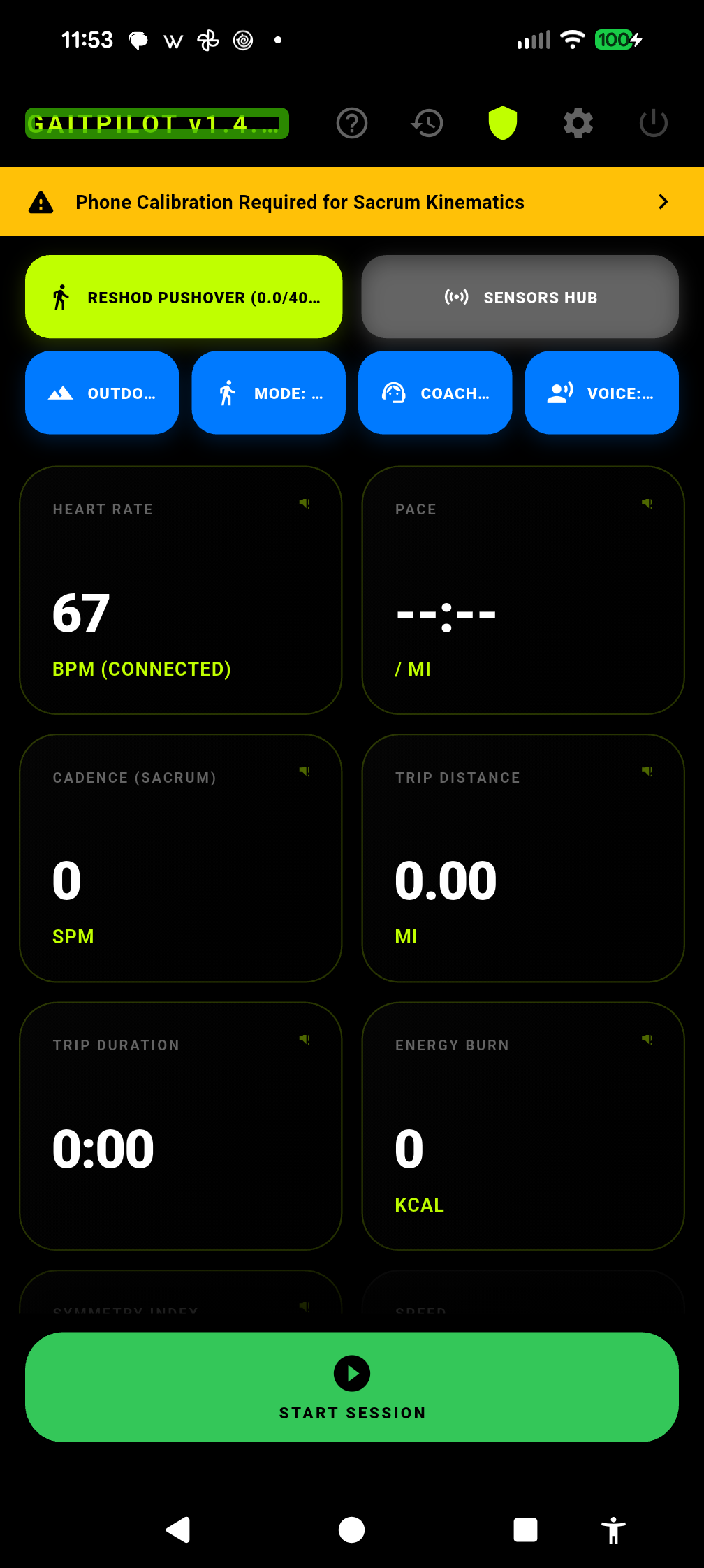
When you open GaitPilot, you are presented with the main telemetry dashboard. Here is how the interface is organized from top to bottom:
1. Top AppBar Navigation (Quick Access Icons)
Located in the upper right header:
* ? Help / User Guide: Opens this comprehensive online documentation and gear guides.
* 🕒 Past Sessions: Opens your complete history of past workouts, filterable by walking mode (Dog Walking, Race Walking, Casual, etc.), with side-by-side longitudinal comparisons.
* 🛡️ Safety & Guardian: Configures emergency contacts, crash/fall/immobility watchdog sensitivity, and automated emergency SMS alerts.
* ⚙️ Settings (Metric Config): Customizes your physical profile (height, weight), cadence sources, coaching personas, and Dog Walking leash options.
* App Version Display: In the top left corner, the current app version (e.g. v1.4.26) is displayed.
2. Hardware & Gear Hub Buttons
Prominently displayed beneath the header:
* 👟 SHOE VAULT: Manage your active footwear rotation (e.g. New Balance 880 v15), track cumulative shoe mileage, and receive warnings when lateral foam compression degrades your stride.
* 📡 SENSORS HUB: Pair, assign, and calibrate your external WT901BLE IMU sensors across 5 anatomical mounting positions (SACRUM, LEFT FOOT, RIGHT FOOT, LEFT WRIST, RIGHT WRIST). It also displays the active readiness status and streaming health for the internal phone sensor, the Wear OS watch, and external hardware (e.g., streaming rates and battery). You can also configure your target cadence selector here.
3. Walking Profile Selector
Tap to switch your active walking mode instantly:
* CASUAL: Standard daily walking and rehabilitation.
* DOG WALK: Specialized canine mode with leash-arm asymmetry suppression and lumbar strain guardian.
* RACE WALK: Olympic competition rules (straight knee at contact, continuous ground contact).
* HIKING: Trail walking with elevation gain tracking and rugged terrain physics.
* RUCKING / VEST: Weighted load carriage monitoring trunk tilt and vertical oscillation.
* BAREFOOT: Unshod natural gait analysis emphasizing midfoot/forefoot strikes and reduced heel impacts.
* RETRO: Backward walking mode tracking reverse propulsion and hamstring/glute activation.
* RESEARCH (Flight Recorder - Beta / Internal Testers): Pure silent observation flight recorder. When selected, an accessible dialog prompts for an Activity Tag (e.g., Trail Run, Sprint Drills, Golf Swing, Bowling, Baseline Race Walk). Mutes real-time voice coaching, cadence tones, and background drones to eliminate athlete observer bias, while the 100 Hz deterministic DSP records high-density kinematics, GCT, impact force, and GPS course telemetry for forensic analysis and session report badging. Long-press the Walking Mode button while in Research to edit your activity tag at any time. (Note: Currently unlocked for internal testers; may be migrated to a dedicated Researcher / Coach Pro feature tier in future releases).
4. Live Telemetry Gauges Grid
Displays real-time digital dials for Speed, Cadence, Symmetry, Ground Contact Time, Impact Force ($G$), Pelvic Tilt, and Foot Progression Angle. * Interactive Expanded Cards: Tap any metric card to slide open its multi-tier historical analytics (SESSION, ANNUAL, and ALL-TIME personal records).
5. Session Control & Tool Bar
Located at the base of the screen:
* START / STOP SESSION Button: Large primary button to initiate live telemetry recording and generate comprehensive post-walk reports.
* 🎵 METRONOME Toggle: Starts audio cadence pacing pulses at your target SPM.
* 🏠 INDOOR / OUTDOOR Mode Selector: Switches between outdoor GPS mapping with environmental weather stations and indoor treadmill physics.
* 🎙️ MIC Button: Manually opens hands-free voice command listening.
* Coaching Mode Selector: Choose your preferred audio coach persona (e.g., Sgt. Major, Dr. Move, Coach Speed, Zen Master).
* Timed Spoken Report Selector: Configure how often the coach announces your progress (e.g., every 1, 2, or 5 minutes).
📡 Sensor Sourcing Transparency & Validity Conventions
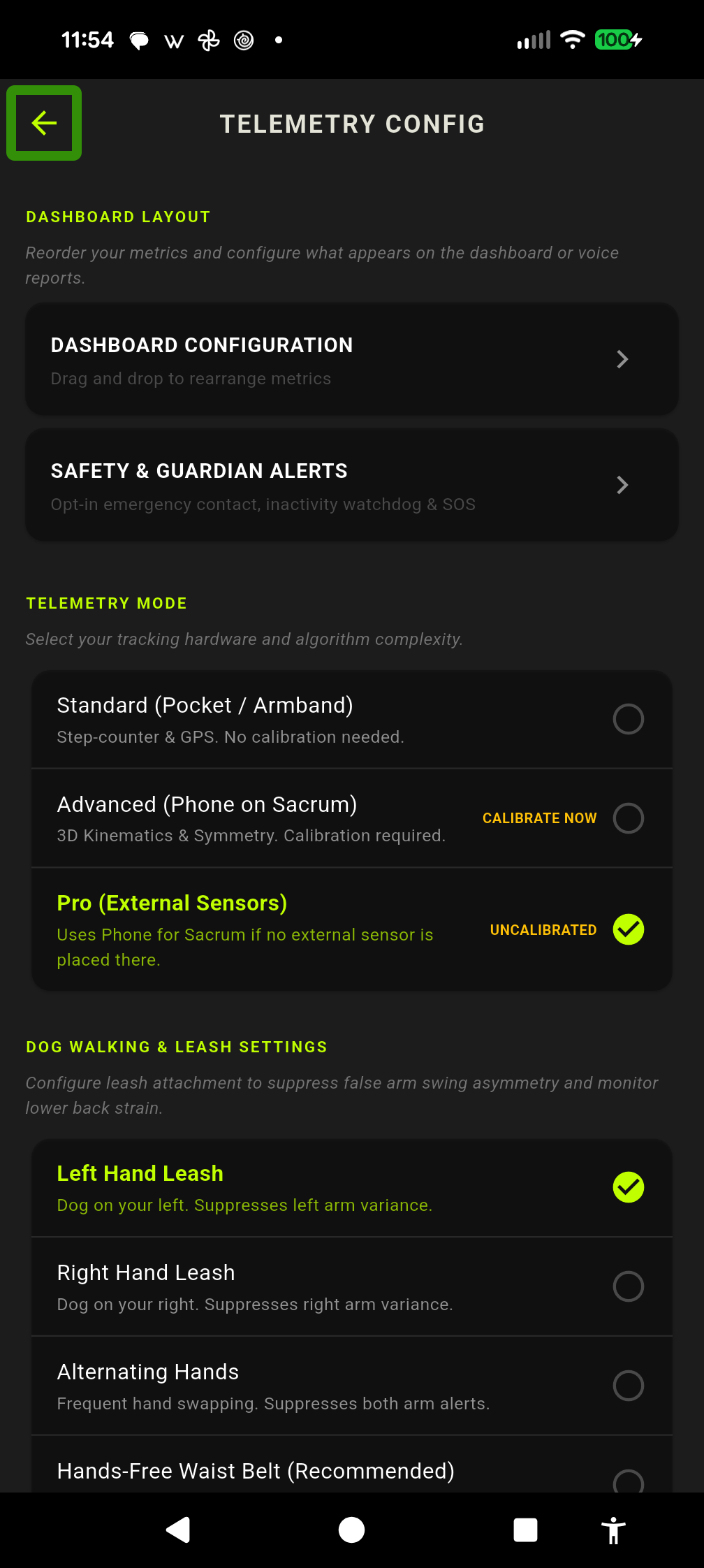
How Users Can Tell Which Metrics Come from Which Source
- Sensor Status on the Dashboard & Sensors Hub:
- When hardware at an anatomical location (WT901 sensor, Wear OS watch, or internal phone belt IMU) is connected and streaming, associated metric cards update in real time.
- If no hardware is connected for a limb, gauges dedicated to that limb (such as shoe roll or wrist swing) safely display
***(no data) rather than guessing. - Dashboard Metric Labels & Configuration Screen:
- You can customize which metrics appear on your dashboard by going to Settings -> DASHBOARD CONFIGURATION.
- Metric labels explicitly state their hardware origin (e.g.
Cadence (Sacrum),Lower Body Cadence (Feet),Left Planted Angle (Shoe),Tilt Angle (Sacrum)). - Session Summary Configuration Snapshot:
- Every generated session report includes a CONFIGURATION SNAPSHOT section showing the exact source assigned during the workout (e.g.,
Sacrum Source: WT901BLE External Node,Cadence Source: Sacrum,Active Shoe: New Balance 860 v15). - Cadence Source Selection (Metronome & Primary Pacing vs Multi-Limb Reporting):
- The Cadence Source setting in Metric Configuration determines which sensor channel governs the primary pacing tachometer, live metronome tones, and primary audio feedback cues (e.g.,
Sacrum,Lower Body (Feet),Upper Body (Wrists),Left Foot,Right Foot,Left Wrist,Right Wrist, orPhone Internal IMU). - Bilateral Lower & Upper Body Cadence (SPM):
- When selecting Lower Body Cadence (Feet) or Upper Body Cadence (Wrists), the app calculates true bilateral Steps Per Minute (SPM). If both limb sensors are active, their turnover rates are combined (
Left + Right); if only a single foot or wrist sensor is active, the single-limb stride rate is automatically doubled (Single × 2) to report true bilateral stepping cadence. - Selecting individual limb sources (e.g. Left Foot Cadence, Right Foot Cadence, Left Wrist Cadence, Right Wrist Cadence) reports pure single-limb cycle turnover rates (strides per minute).
- When selecting Lower Body Cadence (Feet) or Upper Body Cadence (Wrists), the app calculates true bilateral Steps Per Minute (SPM). If both limb sensors are active, their turnover rates are combined (
- Regardless of which source is chosen as the primary pacing driver, all active limb cadences (Sacrum, Left/Right Foot, Left/Right Wrist) are simultaneously tracked and displayed across the dashboard and session summary report for full multi-sensor comparative analysis.
Live Biomechanical Gauges & Validity Conventions
Below the Sensor Hub, you will find real-time data dials: * Speed & Cadence: Your current GPS-derived speed (MPH) and your step frequency (SPM). * Symmetry Index: A percentage evaluating how balanced your left and right sides are. 100% is perfect; anything below 90% indicates a developing limp or fatigue. * Ground Contact Time (GCT): How long your feet stay on the ground. Crucial for race walkers to ensure they aren't lifting.
Universal Interactive Dashboard & Expanded Metric Details Cards
Every single tile on the live dashboard is an interactive, accessible touch target. Tapping any metric tile triggers a gentle haptic confirmation and slides open an Expanded Metric Details Card:
- Uniform Multi-Tiered Statistics:
- SESSION: Displays your active session's running average and peak values (e.g.,
3.2 avg / 4.1 max MPH,91 avg / 95 max BPM,+14.5° avg / +19.7° peak Pronation). - ANNUAL: Automatically tracks and persists your year-to-date historical averages and personal season bests, handling year-boundary rollovers automatically.
-
ALL TIME: Maintains your lifetime career averages and all-time personal records across all walking sessions.
-
Contextual Diagnostics & Quick Action Buttons:
- Heart Rate (
hr): Real-time monitor connection status (Whoop 4.0) with a dedicated "SEARCH FOR HR MONITOR (WHOOP)" pairing button. - Foot Posture & Planted Angles (
left_foot_angle/right_foot_angle): Displays real-time step classification distribution (Neutral,Pronation, andSupinationstep counts). Pre-mount flat-surface calibration remains strictly governed within the External Sensors Hub. - Cadence (
cadence): Real-time pacing target and primary metronome source readout (Sacrum,Feet,Wrists, orInternal IMU). - Bilateral Symmetry (
symmetry): Direct millisecond stance time breakdown (538ms L / 552ms R) and bilateral bias index. - Pelvic & Trunk Kinematics (
tilt/obliquity/rotation): Center-of-mass angular stability range and source attribution. -
Arm Swing Arc (
left_wrist_angle/right_wrist_angle): Bilateral arm pump amplitude and crossover symmetry. -
TalkBack Screen Reader Optimization: All cards are structured with high-contrast, clean semantic labels so non-visual athletes can easily explore deep historical data without UI clutter.
🛠️ Customizing Your Dashboard: Layout Presets & Tri-State Controls (DASH / VOICE / LIVE)
In Settings -> DASHBOARD CONFIGURATION, you have complete granular control over every single metric channel:
- Quick Dashboard Presets:
- Clean Core (Default): Streamlines the view to essential essentials (Speed, Cadence, Symmetry, GCT, and Heart Rate) to prevent cognitive overload.
- Joint Rehab: Emphasizes bilateral stance times, pronation angles, limp detection, and impact shock ($G$) for orthopedic recovery.
- Athletic / Race Walk: Highlights Olympic flight phase warnings, knee extension, propulsive push-off velocity, and high-cadence pacing.
-
Full Pro (All): Displays the entire 18-channel sensor matrix across all five anatomical positions.
-
Drag-and-Drop Reordering:
-
Press and hold the drag handle on any metric row to move it up or down. The top metrics appear prominently at the top of your phone screen.
-
Tri-State Channel Action Buttons: Each metric features three independent, accessible action buttons:
DASH(Visibility): Determines whether this metric card is rendered as a live tile on your main phone dashboard.VOICE(Spoken Reports): Controls whether this metric is announced during timed spoken progress reports (e.g. every 2 minutes) or comprehensive status voice queries ("What's my status?").-
LIVE(Broadcast / Privacy Sharing): Determines whether this metric is broadcast in real time over WebSockets to your Guardian Live Map and Coach Command Center. You can share Speed and Heart Rate while keeping advanced biomechanical angles completely private. -
Timed Spoken Progress Reports:
- Accessible directly from the bottom Toolbar on the dashboard or in settings.
- Configure scheduled audio announcements at intervals of Every 1 Minute, Every 2 Minutes, or Every 5 Minutes (or turn them Off).
- The coach summarizes your elapsed time, total miles, current pace, and all active VOICE-enabled metrics without you ever having to look at the screen.
Telemetry Validity & Range Sentinels (***, ---, +++, and Active Zero)
GaitPilot clearly distinguishes between valid zero-readings and invalid or disconnected metrics:
* 0 (Active Zero / Connected & Stationary): When your phone or external sensor is connected and actively streaming data, but you are not currently moving (such as standing still at a crosswalk or resting), metrics report 0 (e.g. 0 steps per minute, 0.0 mph). TalkBack explicitly announces "0 steps per minute, standing still", giving you immediate confidence that your sensors are connected and functioning properly.
* *** (Invalid / No Data / Disconnected / Stale): Displayed strictly when a sensor is disconnected, has not yet sent live samples, or has stalled. TalkBack announces *** or "No data".
* --- (Under Range / Low): Displayed when a metric is below its operational detection threshold.
* +++ (Over Range / High): Displayed when a metric exceeds its physiological ceiling.
🎙️ Intelligent Audio Coaching, Priority Hierarchy & Foot Slap Sonification
GaitPilot acts as your proactive auditory biomechanics coach, delivering real-time vocal feedback into your earbuds while ensuring you are never overwhelmed with acoustic clutter:
- Four-Tier Audio Priority Hierarchy: To guarantee that urgent guidance is always heard first, the audio engine organizes vocal cues into a strict priority hierarchy:
- Tier 0 (Live Humans & Critical Safety): Direct voice messages from your remote human Coach, check-ins from your Guardian, emergency SOS alarms, and spatial hazard warnings immediately take top priority, pausing any automated feedback.
- Tier 1 (Critical Gait Pathology & Foot Slap): Immediate warnings for acute gait breakdown, including Foot Slap detection, severe limp asymmetry, and pronounced pelvic drop.
- Tier 2 (Lower Extremity Form Corrections): Helpful adjustments for foot pronation, supination, steppage foot drop, and posture alignment.
-
Tier 3 (Upper Extremity Kinematics): Arm swing mechanics, including arm crossover past your chest midline, swing arc balance, and arm drive pacing.
-
Global 8-Second Audio Breathing Room: To prevent rapid back-to-back chatter and ensure you have time to focus on your rhythm, GaitPilot enforces a natural 8-second breathing room between verbal coaching cues. The coach will never talk over itself or deliver conflicting advice at the same moment.
-
Balanced Arm & Wrist Coaching: Upper-body arm drive is an essential engine for walking efficiency. GaitPilot monitors wrist movement and paces arm swing corrections with an expanded 45-second evaluation window. This ensures arm swing guidance is timely and actionable without feeling hyperactive or distracting from your footwork.
-
Foot Slap Pathology Sonification: Foot slap occurs when the forefoot slaps flat against the ground abruptly after heel strike instead of rolling smoothly forward. When detected by your shoe sensors, GaitPilot delivers an immediate haptic pulse and spoken coaching guidance: "Foot slap detected. Gently control the roll of your foot as you land." This real-time feedback helps protect your joints, relieve anterior shin fatigue, and restore smooth heel-to-toe progression.
👤 User Profile & Physical Configuration (Height, Weight, & Profile-Aware Stride Length)
To ensure that your energy expenditure (calories burned), mechanical power, and indoor step distances are calculated with clinical-grade accuracy, you can customize your physical parameters in Settings -> METRIC CONFIGURATION:
- Body Weight (lbs / kg):
- Directly scales the physical mechanical work equation ($1.66 \times \text{Weight (kg)} \times \text{Distance}$).
- Entering your true weight ensures that your calorie burn reflects your real body mass rather than a generic 154 lb (70 kg) default.
- User Height (Inches / cm):
- Moving the USER HEIGHT slider automatically computes and updates your recommended baseline STRIDE LENGTH across all walking profiles using biomechanically tailored scaling multipliers.
- Setting your height automatically establishes athletic stride extensions (+12% for Olympic Race Walking) or loaded shortenings (-10% for Rucking).
- Profile-Aware Stride Length (Inches):
- Governs indoor and treadmill dead-reckoning distance estimation ($\text{Miles} = \frac{\text{Steps} \times \text{Stride}}{63,360}$).
- Independent Calibration Per Walking Mode: Stride length is not one-size-fits-all. When you race walk, your stride naturally lengthens; when you carry a heavy ruck pack or hike uneven trails, your stride naturally shortens. GaitPilot maintains completely independent, persistent stride length calibrations for every walking profile (
Casual,Olympic Race Walking,Power Walking,Rucking,Nordic Pole Walking,Hiking,Retro,Barefoot, andClinical Rehab). - Dynamic GPS Auto-Calibration: You don't need a tape measure! Whenever you walk outdoors with accurate GPS tracking, GaitPilot automatically derives your empirical stride length ($\text{Stride} = \frac{\text{GPS Distance}}{\text{Total Steps}}$). This calibration is calculated at the end of the session. If you switch walking modes during a session, the auto-calibration is discarded for that session to prevent cross-contamination of stride profiles, so stick to one mode per session for accurate calibration. It then saves that calibrated value specifically to your active walking profile for all subsequent indoor sessions.
- How the Settings Slider and Auto-Calibration Work Together (Unified Dial Model): There are never conflicting numbers. The slider in Settings and the background auto-calibration engine share the exact same setting.
- Setting your height sets the dial to your baseline formula.
- Finishing an outdoor GPS walk moves the dial to your empirical real-world measurement.
- Moving the slider manually with your finger instantly overrides the dial. Whichever action happened most recently is always the active number used for all calculations, and that exact number is always displayed directly on your STRIDE LENGTH slider.
- Why You Might Adjust the Slider Manually: Manual adjustment is ideal for indoor-only or treadmill walkers who have not yet walked outdoors with GPS, clinical physical therapy patients with specific shortened step prescriptions, or athletes drilling a specific stride length target.
Quick Reference: Physical Parameters & Mathematical Models
| Parameter | Slider Range | Primary Biomechanical Role | How It Is Calculated / Scaled |
|---|---|---|---|
| Body Weight | 80 to 350 lbs (36 to 159 kg) | Mechanical work & energy expenditure | $\text{Joules} = 1.66 \times \text{Weight (kg)} \times \text{Distance (m)}$; converts directly to active kcal burned. |
| User Height | 48 to 84 inches (122 to 213 cm) | Anthropometric leg length & baseline stride seed | $\text{Baseline Stride} = \text{Height} \times 0.415$ (Casual), scaled dynamically across walking profiles. |
| Stride Length | 20 to 60 inches (51 to 152 cm) | Treadmill dead-reckoning & indoor distance | $\text{Distance (Miles)} = \frac{\text{Steps} \times \text{Stride (in)}}{63,360}$; auto-tuned from GPS walks ($\frac{\text{GPS Miles} \times 63,360}{\text{Steps}}$). |
CRITICAL RULE: Hardware must be attached in exactly the correct orientation every time. Software calibration (tare) does NOT fix upside-down or sideways sensors! If your sensors are attached backward, your forward momentum will be recorded as backward momentum, completely destroying the biomechanical analysis.
- Phone (Sacrum in Spi Belt): If using the phone as your primary sacrum sensor inside a horizontal waist belt, it must be placed horizontally, with the screen facing AWAY from your body, the rear camera facing your body, and the top of the phone (camera side) pointing to your LEFT hip.
- Note on Phone Placement: The app expects this strict horizontal orientation to correctly compute advanced kinematics. If you intend to carry the phone vertically in your pocket or hold it in your hand, you must open the Sensor Hub and set the Internal Phone Sensor toggle to "Pocket / Handheld". This disables the strict physics engine and safely falls back to basic, orientation-agnostic magnitude step tracking.
- WT901 External Sensors (Sacrum, Wrists, Shoes):
- Shoe Mounting: The top Z-Axis label must face UP (away from gravity), the Y-Axis switch to your LEFT, and the X-Axis mounting ears FORWARD.
- Sacrum Mounting: Place the bottom of the sensor flat against your sacrum. The top Z-axis label will point backwards (away from your body). Ensure the Y-Axis power switch points to your LEFT. This means the X-Axis mounting ears will point UP towards your head.
- Wrist Mounting: Wear the sensor like a watch face. The bottom rests against your skin, and the top Z-axis label points away from your wrist. Ensure the Y-Axis power switch points down your arm towards your hands. The X-axis strap will wrap around your wrist.
⚖️ Sensor Calibration Protocol (Flat Surface Pre-Mount vs. Standing)
Proper calibration is essential for accurate biomechanical measurements. GaitPilot enforces two distinct calibration protocols based on sensor placement:
1. Pre-Mounted Flat Surface Calibration (Mandatory for Feet)
- The Method: Before attaching sensors to your feet, place the sensors completely flat on a level table or flat floor with the Z-axis pointing straight up, and initiate calibration in the External Sensors Hub.
- Why This Is Critical for Foot Posture & Shoe Wear:
- Placing the sensors flat sets true physical Earth horizontal ($0.0^\circ$).
- When you mount the sensors to your bare feet or shoes, the DSP engine measures your midstance roll angle relative to the flat ground.
- This allows GaitPilot to accurately measure your natural biological pronation/supination and detect physical midsole foam compression over time.
- Why You Must NEVER Tare Shoe Sensors While Standing on Your Feet:
- If you tare shoe sensors while standing with them on your feet, the software will define your standing foot tilt (such as $12^\circ$ of flat-foot pronation or an inward shoe slant) as "zero".
- During walking, that posture will be subtracted out, causing the report to falsely show $0^\circ$ Neutral and erasing your real foot posture and shoe wear.
- Shoe Sensor Protocol: Place shoe sensors on a level flat table or floor for static reference calibration before lacing them onto your shoes.
2. Standing Resting-Hang Calibration (Wrists & Arms Only)
- The Method: Stand upright with your arms hanging naturally and relaxed at your sides, parallel to your torso, to zero out the resting arm angle.
- This ensures that arm swing is measured relative to your natural standing posture.
3. In-Belt / Mounted Sacrum Calibration Protocol (WT901 or Phone)
- The Method: Mount the WT901 sensor (or clip the phone) securely against your sacrum (L4–S1 lumbar spine) in your belt. Stand completely still and tall in your natural upright posture on level ground, then say "Calibrate" (or tap Tare/Calibrate in the Sensor Hub).
- Why Sacrum Calibration Differs from Shoes: Unlike shoe pods which need an absolute flat horizontal table reference, the sacrum sensor must be calibrated while mounted on your body to capture your individual anatomical upright plumb line ($\approx 0.0^\circ\text{ Tilt}$ and $0.0^\circ\text{ Obliquity}$).
- Phone Sacrum Mounting Geometry: When utilizing the phone's internal IMU as the sacrum sensor, the smartphone must be placed horizontally in landscape orientation with the top edge pointing to your left hip, the bottom charging port pointing to your right hip, and the screen facing outward (posteriorly away from your body).
- Automated Gross Placement Sanity Check: To prevent corrupt baselines caused by accidental orientation mistakes or movement during calibration, GaitPilot automatically executes an automated sanity gate over the 2-second calibration window:
- Excessive Movement Gate: Aborts if movement, shaking, or swaying is detected (sensor magnitude must remain stable between $7.0\text{ m/s}^2$ and $13.0\text{ m/s}^2$).
- Flat Surface Detection: Aborts if the phone is lying flat on a table, floor, or horizontal pouch ($|a_z| > 6.5\text{ m/s}^2$).
- Portrait Mode Gate: Aborts if the phone is held vertically in portrait orientation ($|a_y| > 5.0\text{ m/s}^2$ or $|a_y| > |a_x|$).
- Orientation Inversion Gate: Aborts if the phone is upside down or reversed with the top edge pointing right ($a_x < 3.0\text{ m/s}^2$).
- Accessible Spoken Feedback: If a placement violation occurs, calibration immediately aborts without updating or corrupting the baseline, and the audio engine announces clear, spoken instructions detailing how to reposition the phone.
4. Intelligent Multi-Sensor Calibration & Fallback Protocol
- The Multi-Sensor Challenge: Shoe sensors require an absolute flat table reference, while sacrum and wrist sensors require upright standing wear. In a complete 5-pod setup, triggering a global calibration while standing tall would normally risk corrupting your shoes' flat baseline with an angled stance reading.
- Intelligent Per-Sensor Placement Validation: When you initiate calibration with multiple WT901 sensors connected, GaitPilot evaluates each sensor node independently:
- Shoe Pods (Feet): If lying flat on a table or floor, the new flat earth reference is updated. If mounted on your shoes while standing, GaitPilot detects the angle and deliberately preserves your prior flat table calibration, preventing your shoes from being overwritten! If a shoe sensor has never been calibrated, the app flags: "Foot sensor must be placed flat on a table or floor before calibrating."
- Sacrum Sensor: Calibrates only when mounted upright on your lumbar belt. If accidentally lying flat on a table, the prior baseline is preserved.
- Wrist Sensors: Calibrates while standing with arms relaxed at your sides. If moving or swinging, the prior baseline is preserved.
- Consolidated Spoken Feedback: The voice engine announces an intelligent consolidated report: "Sacrum and wrist sensors calibrated. Foot sensors preserved existing flat calibration."
- Pre-Flight Launch Intercept: When using the phone as the sacrum IMU, GaitPilot runs an instant pre-flight sample before starting a walk. If the phone is oriented in portrait mode, upside down, or flat, the app intercepts the launch, refuses to start an invalid walk, and announces: "Cannot start session. Phone orientation is invalid for sacrum placement. Please adjust your belt."
🚦 Hardware Readiness Checking & Status Badges
On the main dashboard, the Shoe Vault and Sensors Hub buttons display dynamic, real-time readiness indicators so you know your equipment is ready before starting a session:
1. Sensors Hub Readiness Badges
- 🟢 Green (Ready): All configured sensor nodes (Sacrum, Feet, Wrists) are connected over Bluetooth, calibrated, and actively streaming at 100 Hz.
- 🟡 Yellow (Warning / Attention Needed): A connected sensor has not completed its baseline tare/calibration sequence, or a sensor's battery level has dropped below 30%.
- 🔴 Red (Error / Disconnected): A configured sensor failed to connect, lost connection, or stalled mid-stream.
- ⚪ Grey (Internal Only): No external BLE sensors are paired; GaitPilot operates in internal phone-only mode.
2. Shoe Vault Readiness Badges
- 🟢 Green (Optimal Cushioning): Active footwear has accumulated less than 80% of its target mileage lifespan (e.g., < 320 miles on a 400-mile shoe).
- 🟡 Yellow (Approaching Replacement): Active footwear is between 80% and 99% of its mileage limit.
- 🔴 Red (Degraded / Replace Shoe): Active footwear has reached 100% of its mileage limit or the DSP engine has detected severe biomechanical foam collapse and impact force drift.
3. Hardware Streaming Indicators & TalkBack Accessibility
Inside the Sensors Hub, each hardware card (Phone, Wear OS Watch, and external WT901 sensors) features a dedicated real-time streaming indicator dot at the top left of the card title:
* Active Streaming State:
* Visual: Glows vibrant electric lime (#C0FF00) with an ambient pulsing shadow glow.
* TalkBack Announcement: TalkBack explicitly announces "Live streaming" before reading the sensor name and status (e.g., "Live streaming, Left Foot (Shoe), Connected • Streaming • Battery 90%").
* Idle or Disconnected State:
* Visual: The glowing shadow turns off, and the dot dims to a flat translucent grey (Colors.white24). The surrounding card border also turns dark grey or amber.
* TalkBack Announcement: TalkBack announces "Not streaming", and the subtitle indicates "DISCONNECTED" or "PAIRED • IDLE".
* Universal Screen Reader Optimization: This semantic indicator gives non-visual athletes instant, accessible confirmation of whether data packets are actively flowing across Bluetooth or internal buses before starting a workout.
💪 Arm Swing Mechanics & Form Coaching
Your arms play a powerful role in walking efficiency, balance, and speed. GaitPilot actively analyzes your wrist kinematics to help you maximize your performance and prevent fatigue:
- Why Arm Swing Matters: In efficient walking, your arms pump forward and backward to counterbalance your hip rotation, stabilizing your head and torso while reducing the physical effort required by your legs.
- Dynamic Peak-to-Peak Oscillation vs. Static Posture:
- GaitPilot measures dynamic peak-to-peak swing range ($|\text{pitch}{\max} - \text{pitch}|$), not static tilt angle.
- If an arm is held completely still, tucked behind your back, or locked near your sacrum, the dynamic excursion registers as $0^\circ\text{--}5^\circ$, accurately triggering clinical hypokinesia / dead-arm alerts.
- Active Cadence Threshold ($\ge 30\text{ SPM}$):
- In gait biomechanics, reciprocal arm swing naturally emerges at $\ge 30\text{ SPM}$ (or $>0.6\text{ m/s}$).
- GaitPilot activates arm swing biofeedback once cadence exceeds 30 SPM, ensuring that slow, deliberate clinical test walks and post-rehab drills receive full audio guidance.
- Athletic Drive (Olympic Race Walking & Power Walking):
- Keep Elbows Bent: Bending your elbows to approximately 90 degrees shortens the arm lever, allowing you to pump faster with less shoulder fatigue.
- Drive Straight Forward and Back: Keep your arm motion parallel to your ribs. Avoid sweeping your hands inward across the center of your chest, which creates side-to-side torso sway and slows forward momentum.
- Proactive Cadence Boosting: If your cadence slows or your arm drive fades, your audio coach will actively remind you to pump your arms back to instantly drive leg turnover.
- Everyday & Clinical Balance (Casual & Clinical Rehab):
- Symmetric Freedom & Arm Freezing Detection: Natural, rhythmic arm swing is a vital indicator of balance, stability, and neurological health. If one or both arms become stiff or drop their swing motion while your feet are actively moving, GaitPilot identifies this reduced excursion and prompts your coach to cue you ("Warning. Decreased arm swing detected.").
🎧 The Audio Persona Coach & Rate-Limiting Protocol
You don't need to stare at your phone while walking! GaitPilot includes an intelligent Audio Coach that speaks to you through your headphones in real-time.
- Sgt. Major (Tactical): A strict, no-nonsense military cadence caller. Best for rucking and heavy load carriage.
- Dr. Move (Clinical): A calm physical therapist focused on injury prevention. She will warn you if she detects an asymmetric limp or gait variance.
- Coach Speed (Athletic): High energy and motivating. Focuses on your pace, stride efficiency, and keeping your cadence up.
- Zen Master (Mindful): Focuses on deep breathing, smooth posture, and relaxed arm swings.
Intelligent Audio Rate-Limiting (Why the Coach Stays Silent)
To keep your workout peaceful and avoid repetitive chatter, GaitPilot enforces clinical audio debouncing: * Critical Form Alert Lockout (2 Minutes): When a critical alert fires (such as a severe antalgic limp or pelvic drop), the engine applies a 2-minute hard lockout before repeating that critical alert. * Warning Lockout (5 Minutes): Mild warnings enforce a 5-minute cooldown. * Biofeedback Debounce (15 Seconds): Real-time spoken form corrections enforce a 15-second debounce window. * Periodic Status Interval: You can configure periodic pace and distance announcements in settings (e.g. every 1, 2, or 5 minutes) to receive scheduled progress updates independent of form alerts.
🔔 The Cadence Metronome (Pacing Pulses)
If you want to maintain a consistent stepping rhythm without looking at your screen, enable CADENCE METRONOME in Settings -> TELEMETRY CONFIG:
- How It Works: The app generates a crisp, rhythmic acoustic pulse (woodblock / cowbell click) locking in your configured Target Cadence (e.g. 110 SPM for brisk walking, 130+ SPM for power walking).
- Live Rhythm Matching: Simply time your foot strikes to the beat to maintain steady stride efficiency and avoid gradual pace decay on long walks.
- Auto-Muting on Pause: Whenever you pause your session or stop at a street crossing, the metronome silences instantly.
🎵 Real-Time Posture Sonification: The Background Drone
For continuous eyes-free biomechanical feedback without spoken interruption, enable BACKGROUND DRONE in Settings -> TELEMETRY CONFIG:
- How to Interpret Drone Pitch (Sagittal Lean / Trunk Slump):
- Higher Pitch Tone: You are leaning forward or slumping your upper body.
👉 Correction: Lift your chest, pull your shoulders back, and stand tall. - Harmonic Root Pitch (Neutral): Your spine is perfectly upright and aligned with your calibrated standing baseline.
- Lower Pitch Tone: You are over-arching or leaning backward.
👉 Correction: Bring your ribcage down and center your torso over your hips. - How to Interpret Stereo Panning (Coronal Pelvic Drop / Obliquity):
- Tone Panned to Left Earbud: Your left hip is dropping or taking asymmetric lateral load.
👉 Correction: Level your pelvis by engaging your right glute medius and lifting your left hip. - Tone Panned to Right Earbud: Your right hip is dropping.
👉 Correction: Level your pelvis by lifting your right hip. - Centered Balanced Tone: Your hips are level and symmetrical throughout your gait cycle.
Quick Comparison: Cadence Metronome vs. Background Drone
| Feature | Cadence Metronome | Background Drone Sonification |
|---|---|---|
| Audio Acoustic Style | Discrete, rhythmic percussion click (cowbell/woodblock) | Continuous harmonic synthesizer tone |
| Biomechanical Focus | Step turnover frequency (When to step) | 3D spine and pelvic alignment (How to hold posture) |
| Audio Behavior on Turns / Tilts | Constant beat locked to configured Target SPM | Modulates pitch (sagittal lean) and stereo pan (pelvic drop) |
| Ducking & Auto-Muting | Mutes instantly when stopped or when coach speaks | Ducks smoothly under spoken coach announcements and sirens |
| Best Used For | Pacing consistency, cadence drills, race walking turnover | Preventing lower back slump, lateral hip drop, and fatigue |
📊 The Session Report Screen
When you finish your workout (or import an offline SD card session), the app generates a comprehensive, 4-tab Session Report:
- SUMMARY (Tab 1): Your core workout metrics: Total miles, average pace, max speed, total steps, active duration, energy burn (calories), heart rate, and the composite Gait Form & Symmetry Score.
- METRICS (Tab 2): Deep-dive biomechanics: Pelvic tilt angles, sacrum oscillation, coronal obliquity, arm-swing ranges, and stance-phase planted shoe angles.
- Planted Angles (Shoe Angles): Captured precisely when your foot is planted firmly on the ground (during the Zero-Velocity Update or ZUPT phase), filtering out airborne swing flutter.
- Foot Posture & Roll Steps (Supination / Pronation): Classifies each step into Severe Supination ($< -2^\circ$), Mild Supination ($-2^\circ \text{ to } 3.9^\circ$), Neutral ($4^\circ \text{ to } 10^\circ$), Mild Pronation ($10.1^\circ \text{ to } 15^\circ$), or Severe Pronation ($> 15^\circ$).
- INSIGHTS (Tab 3): Movement quality scorecard, pathology audit, and coaching log:
- Form Deviations & Pathology Auditing: Timestamped entries of all detected biomechanical deviations (impact deceleration shock spikes $>2.5\text{G}$, excessive pronation/supination rolls, pelvic drop, bent knee, lifting violations, foot slap). Each deviation features an explicit delivery status badge:
[Spoken]: The audio engine actively voiced this correction to the athlete.[Held Back: <Reason>]: The engine logged the deviation for forensic review but held back the voice alert (e.g.Priority Cooldown,Higher Priority Conflict,Rate Limiter, orVoice Alerts Disabled) to avoid sensory overload and protect athlete focus.
- Coaching Log: Complete, timestamped transcripts of real-time audio cues, elbow drive prompts, metabolic hydration alerts, and two-way coach/guardian communications.
- Clean Form Positive Reinforcement: When zero form breaks occur, displays an encouraging green confirmation: "Clean Gait Form — Zero violations detected!".
- MAP & HAZARDS (Tab 4 - Outdoor Only):
- Interactive high-contrast dark Google Map displaying your route polyline, start/stop pins, and encountered hazards.
- Route Hazards & Markers List: Manage geotagged street obstacles (potholes, ice, low branches) with interactive Save / Delete switches.
- Indoor Adaptation: When Indoor Mode is active (or no GPS was acquired), the Map tab is automatically omitted, leaving a clean, focused 3-tab layout.
Session Summary Actions
At the bottom of the session report screen, you have several powerful options: * SYNC TO DASHBOARD: Uploads the session data to the Cloud Backend so your coach or followers can review it on the 3D Avatar web app. * SHARE: Generates a clean text summary of your workout that you can text or email to anyone. * SAVE LOCALLY: Closes the session and saves it locally to your device's past sessions database.
🎙️ Hands-Free Voice Commands & Volume Triggers
GaitPilot allows 100% eyes-free operation using physical phone buttons, wired earbud buttons, and voice commands:
- Triggering Voice Recognition: Double-tap either physical volume button on your phone (or double-tap your headset button, or tap the
🎙️ MICbutton on the bottom Tool Bar of the dashboard). The app gives an immediate heavy haptic pulse and begins listening with zero delay (no spoken prompt delays your speech). - Complete Suite of Voice Commands:
- Session Control:
start/begin/resume: Starts or resumes live tracking.pause/stop: Pauses live tracking and silences continuous pacing tones.finish/end/done/exit/quit: Finishes the session, saves all biomechanical records to the local database, and closes the session.
- Sensor Calibration:
calibrate/calibration: Initiates a 5-second sacrum baseline alignment countdown. (Stand tall in upright posture while wearing the sacrum sensor).
- Single Metric Queries:
speed: Announces current speed (e.g., "4.2 miles per hour").pace: Announces current pace (e.g., "14 minutes, 15 seconds per mile").distance/miles: Announces total session distance.cadence/steps: Announces current step rate (SPM) and total steps.heart rate: Announces current heart rate (BPM).elevation: Announces current accumulated elevation gain.tilt/oscillation/symmetry: Announces pelvic posture and center-of-mass balance.upper body cadence/lower body cadence: Announces limb-specific cadence turnover.
- Full Workout Status:
status/report/all/everything: Spoken comprehensive summary of duration, distance, pace, and symmetry.
- Spatial Hazard Management:
hazard [description]ormark [description]: Marks a geographic hazard at your current location (e.g., "hazard icy patch", "mark low branch").delete hazardorremove hazardorundo hazard: Deletes the most recently logged hazard for this session.
- Help:
helporcommands: The Audio Coach reads aloud the complete list of available voice commands.
⌚ Wear OS Watch Companion App
GaitPilot includes a companion Wear OS app that acts as a wrist-mounted sensor node, haptic coach, and hands-free control panel. When you open the phone app, the watch wakes automatically — no pairing code or manual launch required.
Key capabilities: * Automatic activation when the phone app opens * Haptic pace keeper — distinct wrist vibrations for cadence, warnings, and hazard confirmations * Wrist hazard logging — tap a button or speak a description to mark a geo-tagged hazard without touching your phone * Arm swing telemetry — 100Hz IMU data streamed to the DSP engine as an upper-body sensor node * Heart rate and HRV via Android Health Services * Zero-power battery monitoring — reports each 1% drop to the phone Sensor Hub with no idle CPU cost
For the complete guide including setup, vibration patterns, troubleshooting, and wrist assignment, see the Wear OS Companion App Guide.
🗺️ Spatial Hazard Radar & Map Pins
GaitPilot includes a proactive 3D Spatial Hazard Radar designed for eyes-free navigation:
- Logging Hazards: You can mark hazards via voice command or screen tap. Each hazard captures exact GPS coordinates, timestamp, and custom tag.
- Note on GPS Requirement: You must be actively tracking a session to log a hazard. If you attempt to log a hazard outside of an active session, the app will reject it with a "no GPS available" warning. This is strictly intentional—GaitPilot keeps the GPS hardware asleep when not tracking a session to preserve your battery life, and spatial hazards are only relevant when mapped to an active route.
- Map Pin Visualizer: On the Session Report Screen, open the MAP & HAZARDS tab to see your route. Logged hazards are displayed as interactive yellow pin markers. Tapping any pin displays the hazard description and timestamp.
- Map & Hazards Tab Management: The MAP & HAZARDS tab in the Session Report allows you to review and manage hazards:
- New Hazards: Hazards you manually logged during the current session are checked by default. Uncheck any hazard you wish to discard.
- Encountered Hazards: Previously saved hazards that you walked past (and were alerted to) during the session. If a hazard is no longer present, you can check its box to permanently delete it from your saved list.
- When you tap "Close Report", all unchecked new hazards are discarded, and all checked encountered hazards are deleted.
- Proximity Radar Audio Alerts: When tracking active sessions, if you re-approach a previously logged hazard within a localized 3D distance buffer, the system speaks a predictive audio warning (e.g., "Approach Warning: Pothole ahead").
👟 Shoe Vault, NFC Tap-to-Equip, & Footwear Intelligence
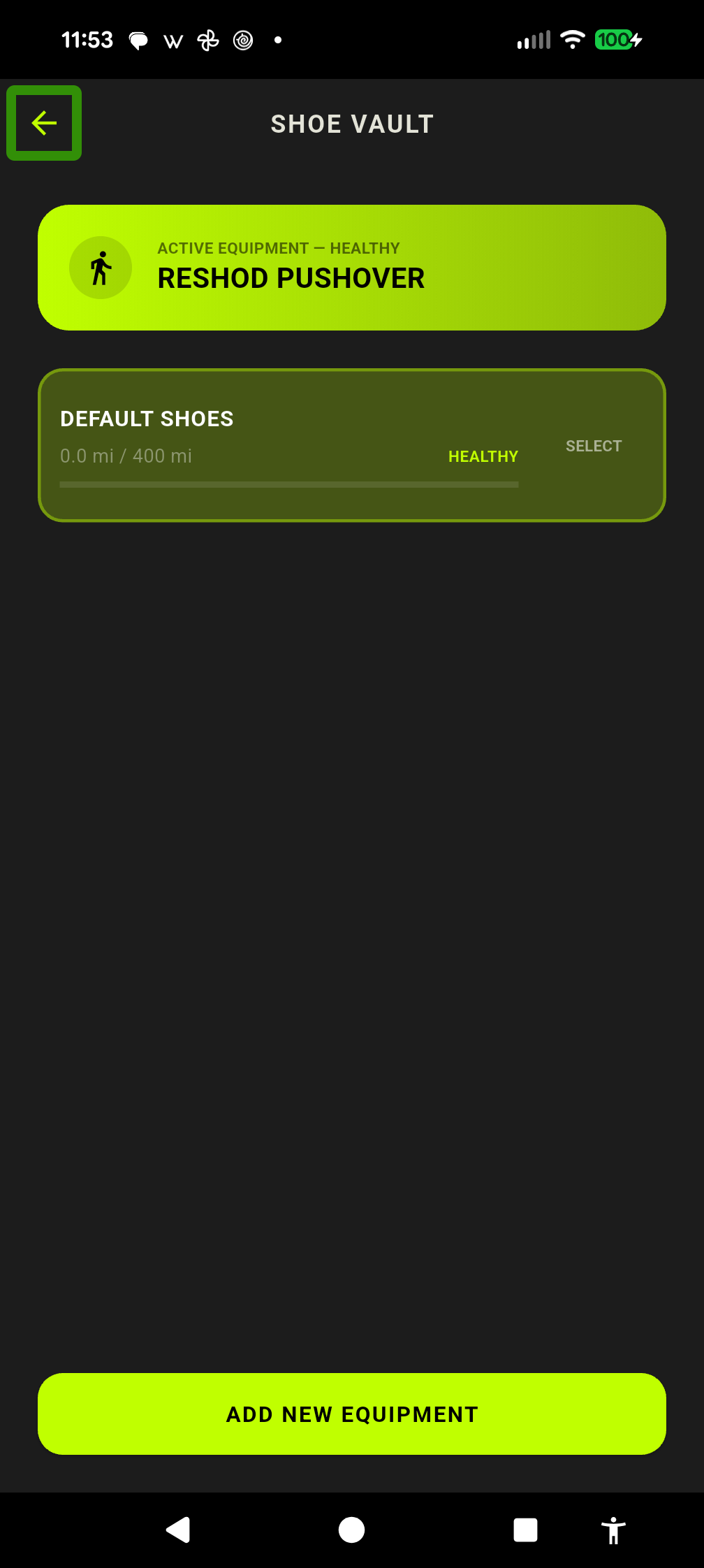
Protect your joints and prevent overuse injuries by monitoring footwear wear, midsole foam breakdown, and instant equipment assignment:
- Registering Footwear: Open the Shoe Vault menu to add your walking shoes, set brand/model details, and specify a target mileage limit (default: 400 miles).
- Automatic Mileage Accumulation: Distance from completed sessions is automatically logged against your active footwear.
- Dynamic Biomechanical Midsole Degradation: Beyond simple mileage, GaitPilot uses high-frequency motion sensors to detect real physical foam breakdown:
- Impact Shock Drift: As midsole cushioning packs out, peak heel strike forces rise from a fresh 1.35 G up to 2.2+ G.
- Planted Angle Drift: As the medial arch foam collapses under your body weight, your planted angle drifts deeper into severe pronation over hundreds of miles.
- Ground Contact Time: Dead foam loses its energetic rebound, causing stance dwell times to lengthen.
- The Edge-First Override: If GaitPilot detects a severe rate of kinematic roll violations or impact spikes, the Shoe Vault overrides the mileage gauge and displays a DEGRADATION WARNING to alert you to replace the shoes before injury occurs.
- NFC Tap-to-Equip (Instant Smart Footwear Switching):
- You can make any pair of shoes instantly smart by placing an inexpensive adhesive NFC sticker (Type 2 / NTAG213 or NTAG215) on the shoe tongue or heel.
- Before heading out for a walk, simply tap the back of your phone to the shoe tongue. GaitPilot instantly identifies the shoe ID, switches the active pair in the Shoe Vault, and announces the shoe name via text-to-speech ("Equipped New Balance 880"), zero screen taps required.
[!NOTE] Understanding Live Pronation Angles (The 3-Step Rule) If you are looking at the live dashboard while standing perfectly still, the shoe angles will read
0.0. This is strictly intentional! GaitPilot uses a Zero Velocity Update (ZUPT) algorithm to find the absolute most stable millisecond of your stance. It does not output an angle until your foot pushes off the ground. Furthermore, it uses a 5-step median filter to reject outliers (like stepping on a rock). Because the filter starts empty, you must walk for at least 3 full steps before the engine mathematically flushes the initial zeros and the true planted angle appears on the dashboard.
Evaluating Corrective Footwear & Orthotics (Barefoot Baseline vs. Shod)
If you want to use GaitPilot to see exactly how much your footwear, dynamic insoles, or orthotics are correcting your natural foot posture, use this standardized diagnostic workflow:
1. The Standardized Footwear Comparison Workflow: 1. Calibration: Calibrate your Left and Right Foot WT901 sensors flat on a level table or floor (never while standing) to establish true horizontal Earth zero. 2. Barefoot Baseline Walk: Mount the sensors securely across your bare instep using elastic silicone foot bands. Open the app, select the Barefoot profile, and walk for 50 to 100 steps. Save the session as your Barefoot Natural Baseline. 3. Footwear Evaluation Walk: Attach the sensors securely to your shoe laces using the standard foot pod clips. Open the app, select the Casual (or Diagnostic) profile, and walk the same distance with your neutral walking shoes and insoles (such as SOLE Performance Medium dynamic footbeds). Save the session as your Footwear Test.
2. How to Review and Score Corrective Footwear Results: Open the Session Report for both walks and compare the Dynamic Foot Cluster metrics under the METRICS tab:
- Ideal Correction (Success):
- Pronation or Supination steps drop significantly compared to barefoot.
- Neutral steps increase to 70%–100% of total steps.
- Planted Angles shift from extreme angles into the target 4.0° to 10.0° neutral range.
- Under-Correction (Insufficient Support):
- Pronation steps remain high (>30% of steps) or Planted Angles remain above 12°–15°.
- Diagnosis: The footwear lacks adequate arch stiffness or midfoot support for your foot structure.
- Over-Correction (Excessive Wedging):
- A previously pronating foot is forced into supination (Planted Angle < 2.0° or high supination step count).
- Diagnosis: The arch support or medial post is too aggressive, placing excessive lateral strain on the outer ankle and knee.
- Asymmetrical Correction:
- One foot achieves neutral alignment while the other continues to pronate or supinate.
- First-Line Intervention: As demonstrated in our longitudinal case studies, pairing supportive neutral footwear with moldable semi-rigid footbeds (such as SOLE Performance Medium insoles) provides effective anatomical stabilization and corrects asymmetry before resorting to costly prescription custom orthotics.
3. Midsole Breakdown & Longevity Monitoring: Use this same comparative test every 100 miles (or when your shoes in the Shoe Vault approach 300–400 miles). If a shoe that originally delivered 90% neutral steps begins showing rising pronation step counts and higher impact shock ($G$), the midsole EVA foam has compressed and the shoe should be retired.
- Foot Progression Angle (FPA / Toe-In vs. Toe-Out) & Strike Pattern:
- Foot Progression Angle (FPA): Measures whether your toes point straight forward, inward, or outward relative to your walking direction during midstance:
- In-Toeing (Pigeon-Toed, $<0^\circ$): Medial toe pointing that can increase lateral knee torque and outer foot wear.
- Normal Progression ($5^\circ \text{ to } 15^\circ$): The biomechanically ideal slight flare for forward propulsion and hip clearance.
- Excessive Out-Toeing (Duck-Footed, $>20^\circ$): Excessive outward flare that reduces forward push-off efficiency by up to 15%, places strain on the inner knee, and increases medial forefoot load.
- Strike Pattern Classification: Evaluates the angle of your shoe at initial ground contact:
- Rearfoot Strike (Heel Strike, $>10^\circ$): Standard for fitness and race walkers.
- Midfoot Strike ($-5^\circ \text{ to } 10^\circ$): Balanced contact optimal for load carriage and natural barefoot gait.
- Forefoot Strike ($<-5^\circ$): Landing on the ball of the foot.
- Push-Off Peak Angular Velocity ($\omega_y$) & Propulsive Power:
- Measures the peak angular velocity (in $^\circ/\text{s}$) generated by the foot during terminal stance and pre-swing (toe-off).
- Normal Push-Off ($\ge 200^\circ/\text{s}$): Healthy calf (gastrocnemius/soleus) power generation driving efficient forward momentum.
- Weak / Hypokinetic Push-Off ($< 150^\circ/\text{s}$): Ineffective propulsion, often seen in sedentary fatigue, Parkinsonian hypokinesia, or Achilles/calf weakness.
- Foot Slap Detection & Pretibial Landing Control:
- Measures the deceleration transition from Initial Contact (IC) to Foot Flat (FF).
- If the foot snaps down flat in $\le 35\text{ ms}$ accompanied by high rotational velocity ($\ge 250^\circ/\text{s}$), a Foot Slap event is recorded.
- Detects eccentric weakness of the tibialis anterior (dorsiflexors), common in peripheral neuropathy or early L5 radiculopathy before full foot drop occurs.
Taking Your Foot Posture Report to the Shoe Store
When visiting a specialty walking shoe store or athletic footwear specialist, open your latest Session Summary (or tap SHARE to generate the plain text summary):
- How to Read the Dynamic Foot Cluster:
- Left & Right Planted Angles: The average and maximum eversion/inversion angle locked in during the stable midstance phase of each step.
- Neutral Steps ($4^\circ \text{ to } 10^\circ$): Normal biomechanical foot strike.
- Pronation Steps ($>10^\circ$): Inward ankle roll. Mild pronation ($10.1^\circ \text{ to } 15^\circ$) is common; Severe pronation ($>15^\circ$) indicates arch collapse.
- Supination Steps ($<4^\circ$): Outward foot strike / high rigid arch.
- Foot Progression Angle (Toe-In / Neutral / Toe-Out): Transverse foot orientation and alignment per foot.
- Foot Strike Pattern (Heel / Midfoot / Forefoot): Initial contact mechanics.
- Push-Off Power & Velocity: Propulsive drive ($^\circ/\text{s}$) at toe-off per foot.
- Foot Slap Incidents: Count of uncontrolled landing impacts per foot.
-
Impact Force & Ground Contact Time: Shows shock absorption ($G$) and stance duration ($s$) per foot.
-
Footwear Recommendations by Posture Distribution:
- If Neutral Steps dominate (>70%): You have a natural, balanced arch. Ask for Standard Neutral or Cushioned Neutral walking shoes.
- If Pronation Steps dominate: Your arch collapses inward during stance. Ask for Stability Shoes (with medial posting or guide rails) or structured arch-support insoles.
- If Severe Over-Pronation dominates (>15°): Ask for Motion Control Shoes or consult a podiatrist for custom orthotics.
- If Supination Steps dominate: Your foot rolls outward, placing load on the outer edge. Ask for Plush, Flexible Neutral Shoes with maximum cushioning to disperse lateral shock.
- If Asymmetrical (e.g., Left Neutral, Right Pronation): Show the exact Left/Right Planted Angles to the footwear specialist to tailor custom lacing or targeted insoles.
Comparing Two Sessions in Past Summaries
To evaluate the before-and-after biomechanical impact of a new shoe, orthotic insole, or medical intervention: 1. Open the drawer or menu and select Past Summaries. 2. Tap the COMPARE button in the top app bar to activate comparison mode. 3. Tap or check exactly 2 sessions from your history (e.g., your Baseline fatigued shoe session and your Target re-test session). 4. Tap the prominent neon button COMPARE 2 SESSIONS at the bottom of the screen. 5. An interactive comparison modal displays exact side-by-side delta metrics across: - Planted Angles (Left & Right): Midstance roll angle correction in degrees. - Impact Force (Left & Right): Peak deceleration force reduction in $G$. - Ground Contact Time (GCT): Left and right contact durations in milliseconds. - Asymmetry Bias: Bilateral weight-bearing distribution shift toward 50.0%. - Core & Pelvic Dynamics: Sacral yaw surge and stance vaulting ratio. - Contralateral Cross-Body Lag: Arm-to-opposite-foot timing synchronicity. 6. Use the COPY or SHARE buttons to export the full comparative report for your coach, physical therapist, or podiatrist.
🚶♀️ Walking Profiles & Coaching Personas
1. Walking Profiles (Walking Modes)
GaitPilot adapts its real-time analytics algorithms based on your active walking profile:
* Casual (casual): Standard recreational walking. Focuses on basic symmetry, step counts, and a relaxed, natural gait.
* Power Walking (power): Fast-paced walking. Focuses on stride speed, driving the arms, and a quick cadence.
* Olympic Race Walking (race): Competitive race walking. Actively monitors the strict biomechanical rules of flight phase (lifting) and knee extension (bent knee).
* Rucking (rucking): Walking with a weighted backpack. Evaluates trunk slump/leaning angles and vertical oscillation (bounce) to protect the spine.
* Weighted Vest (weightedVest): Walking with body weights. Similar to rucking, with a focus on impact shock and posture.
* Nordic Walking (nordic): Walking with trekking poles. Evaluates upper-body arm drive symmetry and pole-sync timing.
* Hiking (hiking) & Trail Walking (trail): Walking on uneven terrain. Relaxes symmetry and cadence thresholds to prevent false alerts on rocky/steep paths.
* Clinical Rehab (clinical): Gait correction after injury. Prioritizes antalgic limp detection, weight-bearing asymmetries, and ankle rotation angles.
* Retro Walking (retro): Backward walking. Monitors rear foot strike angles and stability control.
2. Coaching Personas
Choose the voice assistant that best fits your training style in settings: * Sgt. Major (Tactical): Strict, loud, and direct. Ideal for rucking, weighted vests, and pushing through tough training sessions. * Dr. Move (Clinical): Gentle, informative physical therapist tone. Focused entirely on safety, recovery, and correct form to prevent joint strain. * Coach Speed (Athletic): High-energy, motivating athletic walking coach. Focuses on keeping your pace high, cadence fast, and pushing your stride limits. * Zen Master (Mindful): Calm, soft voice focusing on breathing, relaxation, posture, and smooth arm movements.
3. Environmental & Weather-Adaptive Coaching
GaitPilot uses real-time ambient weather sensors and atmospheric telemetry to optimize your energy expenditure and hydration pacing: * Barometric Pressure & Altitude Adaptation: The app's barometer detects elevation shifts and adjusts your caloric energy expenditure to reflect the higher cardiac and lung workload required when walking at high altitudes. * Thermal Stress & Heat Index Intelligence: High relative humidity blocks sweat from evaporating easily. On hot, humid days (Heat Index over 80°F), GaitPilot accounts for cardiovascular drift and adjusts your caloric burn. * Dynamic Hydration Alerts: While normal walks feature water reminders every 20 minutes, extreme heat and humidity automatically shorten the reminder to every 12 minutes, actively prompting you to replenish with electrolyte fluids to prevent dehydration and muscle cramps.
⚠️ Biomechanical Violation Conditions
When active sensors detect irregular gait patterns, they trigger timestamped violations that are listed in the Pathology tab and announced by your coach:
| Violation | Meaning / Trigger | What it Indicates | Recommended Action |
|---|---|---|---|
| Severe Over-Pronation | Ankle rolls inward >15.0° during stance. | Excessive inward ankle loading; flat feet or worn out shoes. | Use supportive insoles; inspect footwear cushioning. |
| Mild Over-Pronation | Ankle rolls inward 10.1° to 15.0°. | Slight inward loading, generally acceptable but monitor. | Monitor footwear for asymmetrical wear. |
| Neutral Alignment | Ankle roll between 4.0° and 10.0°. | Healthy biomechanical alignment. | Keep it up! |
| Mild Supination | Ankle rolls outward -2.0° to 3.9°. | Slight outward loading, higher arches. | Monitor footwear for lateral wear. |
| Severe Supination | Ankle rolls outward < -2.0°. | Rigid outward ankle loading; high arches. | Use flexible neutral shoes; check outer edge outsole wear. |
| Lifting | Both feet lose ground contact >40ms. | Loss of continuous contact (flight phase) / floating. | Shorten your stride; keep your rear toe on the ground longer. |
| Bent Knee | Advancing leg is bent at heel strike or stance. | Inefficient race walking form. | Focus on fully straight-knee contact until your body is vertical. |
| Steppage | Excessive vertical leg lift during swing phase. | Foot drop; compensation for dragging toes. | Focus on active ankle dorsiflexion (lifting your toes up). |
| Spastic/Scissors | Sudden deceleration/crossover leg swing. | Crossed-over stride or high-impact braking. | Focus on wider, parallel footsteps; land softly on the heel. |
| Propulsive | Forward trunk lean exceeds 20°. | Slouched posture; loss of center of mass balance. | Pull your shoulders back and stand upright. |
| Trendelenburg | Pelvis/sacrum drops laterally >15°. | Weak hip stabilizers (gluteus medius). | Level your hips; incorporate glute strengthening exercises. |
| Arm Centerline | Wrist crosses the torso's vertical midline. | Rotational inefficiency; side-to-side arm sway. | Keep arm drive parallel to your body (pendulum swing). |
| Arm Pendulum | Arm swing pitch swing exceeds 120°. | Excessively large or uncontrolled arm swings. | Keep elbows bent at 90° and swings compact. |
| Foot Slap | $\text{IC} \rightarrow \text{FF} \le 35\text{ ms}$ with $\ge 250^\circ/\text{s}$ pitch acceleration. | Pretibial / anterior tibialis eccentric weakness; early neuropathy. | Focus on gentle heel-to-toe rolling; consult physical therapist. |
| Weak Push-Off | Peak propulsive velocity $< 150^\circ/\text{s}$ at toe-off. | Inadequate plantarflexion power; calf/Achilles weakness or fatigue. | Drive actively off the first metatarsal head (big toe). |
🔔 Warning & Error Conditions Reference
This section outlines system notifications, error screens, and how to resolve them:
1. Sensor Readiness & Warnings
- "Notice: External sensors uncalibrated" (Yellow Banner):
- Meaning: One or more connected WT901 sensors have not completed the baseline tare sequence.
- Resolution: Stand completely still on level ground, double-tap your volume button, and say "calibrate" (or click the Tare/Calibrate button in the Sensor Hub).
- "Notice: [Placement] sensor battery low" (Yellow Banner):
- Meaning: The specified external sensor's battery is below 30%.
- Resolution: Complete your session soon or charge the sensor.
- "Notice: Phone Sacrum uncalibrated" (Yellow Banner):
- Meaning: Phone is in Sacrum Mode (pocket/belt) but has no baseline gravity orientation.
- Resolution: Stand tall and tap Calibrate Sacrum on the main dashboard.
2. Device & Hardware Errors
- "Notice: [Placement] sensor config error / no data" (Red Banner):
- Meaning: The WT901 sensor is paired but is not streaming sensor frames.
- Resolution: Turn the physical sensor switch off, wait 3 seconds, and turn it back on. If it persists, toggle your phone's Bluetooth.
- Stalled Sensor Alert (Grey Sensor Icon):
- Meaning: A sensor stopped sending data for more than 1.5 seconds mid-session.
- Resolution: Ensure the sensor did not slip off, power off, or go out of Bluetooth range.
3. Cloud Sync & Network Errors
- "Cloud Upload Timeout / Server Connection Failed" (SnackBar Toast):
- Meaning: The cloud server took too long to respond (cellular timeout or GCP serverless cold start).
- Resolution: Ensure you have a stable data connection. The app automatically retries twice. If it fails, your data remains safely stored in the local outbox directory; you can sync it manually once you are back on Wi-Fi.
- "Upload over Cellular Data?" (Modal Prompt):
- Meaning: You are finishing a session on mobile data instead of Wi-Fi.
- Resolution: Tap Yes to upload immediately (uses ~1-5 MB), or No to hold the upload in the queue until you connect to Wi-Fi.
💾 The "Edge-First" Philosophy & Past Summaries
GaitPilot was built with an Edge-First philosophy. This means that instead of relying on a constant cloud connection to crunch your data, the app utilizes your smartphone's processor to calculate your biomechanical physics and summary metadata locally, during your walk.
This locally computed data is stored directly on your phone's internal database (the "Local DB"), ensuring you have instant access to your analytics regardless of your cell service.
The Past Summaries Screen
Because of this edge-first architecture, you can access your Past Summaries Screen at any time. This screen allows you to: * View Macro Trends: Review your historical average flight time, asymmetry bias, and pace improvements across multiple sessions. * Access Offline: Instantly view these reports even if your phone is in Airplane Mode or you are deep in the woods without internet access. * Manage Cloud Syncs: Any sessions that have not yet synced to the cloud due to connection issues or data limits will safely remain in your local queue until you connect to Wi-Fi.
Barefoot Baseline Diagnostic & Adaptive Sensitivity
When Barefoot mode is enabled, the DSP engine automatically adjusts its cadence tracking and step detection sensitivity to accommodate the naturally softer impact dynamics of barefoot walking: * Adaptive Step Thresholds: Lowered to 0.18 G at the sacrum and 0.35 G at the feet, reliably capturing gentle indoor steps down to speeds <= 1.0 mph. * Foot-Driven Posture Analysis: During stance-phase Zero-Velocity Updates (ZUPT), the engine analyzes coronal foot roll to classify steps into Neutral, Pronation (inward roll), and Supination (outward roll). This analysis is derived directly from the foot pods and operates with 100% fidelity even when walking without a sacrum sensor.
Session Summary Reports & The "Insights" Tab
When a session concludes, the Session Summary Screen delivers a comprehensive yet context-aware post-walk report:
1. SUMMARY (Tab 1): Executive overview of duration, distance, pace, total steps, energy burn, heart rate, and the Gait Form & Symmetry score.
2. METRICS (Tab 2): In-depth 100 Hz kinematic breakdowns: Sacrum Kinematics (Tilt, Obliquity, Rotation, Oscillation), Arm Swing excursion, Dynamic Foot Cluster, and Multi-Node Limb Cadences.
3. INSIGHTS (Tab 3): Movement quality scorecard and coaching log:
- Form Violations: Timestamped logs of any impact deceleration shock spikes ($>2.5\text{G}$), excessive pronation/supination rolls, or pelvic drops.
- Coaching Log: Transcripts of real-time audio cues, metabolic hydration alerts, and cadence guidance.
- Clean Form Positive Reinforcement: When zero form breaks occur, displays an encouraging green confirmation: "Clean Gait Form — Zero violations detected!".
4. MAP & HAZARDS (Tab 4 - Optional / Outdoor Only):
- Interactive high-contrast dark Google Map displaying your route polyline, start/stop pins, and encountered hazards.
- Route Hazards & Markers List: Manage geotagged street obstacles (potholes, ice, low branches) with interactive Save / Delete switches.
- Indoor Adaptation: When Indoor Mode is active (or no GPS was acquired), the Map tab is automatically omitted, leaving a clean, focused 3-tab layout.
App Settings & Biomechanical Insights Configuration
The app settings menu provides two distinct toggles for controlling how gait abnormalities are handled: 1. Pathology / Insights Analysis: When enabled, the DSP engine continuously analyzes your gait for form deviations and logs them into the INSIGHTS tab of your Session Summary for review by you or your physical therapist. 2. Pathology Voice Alerts: When enabled, the live audio coach will announce form breaks the moment they occur in real time.
🛡️ Guardian & Walker Safety Features (Opt-In Suite)
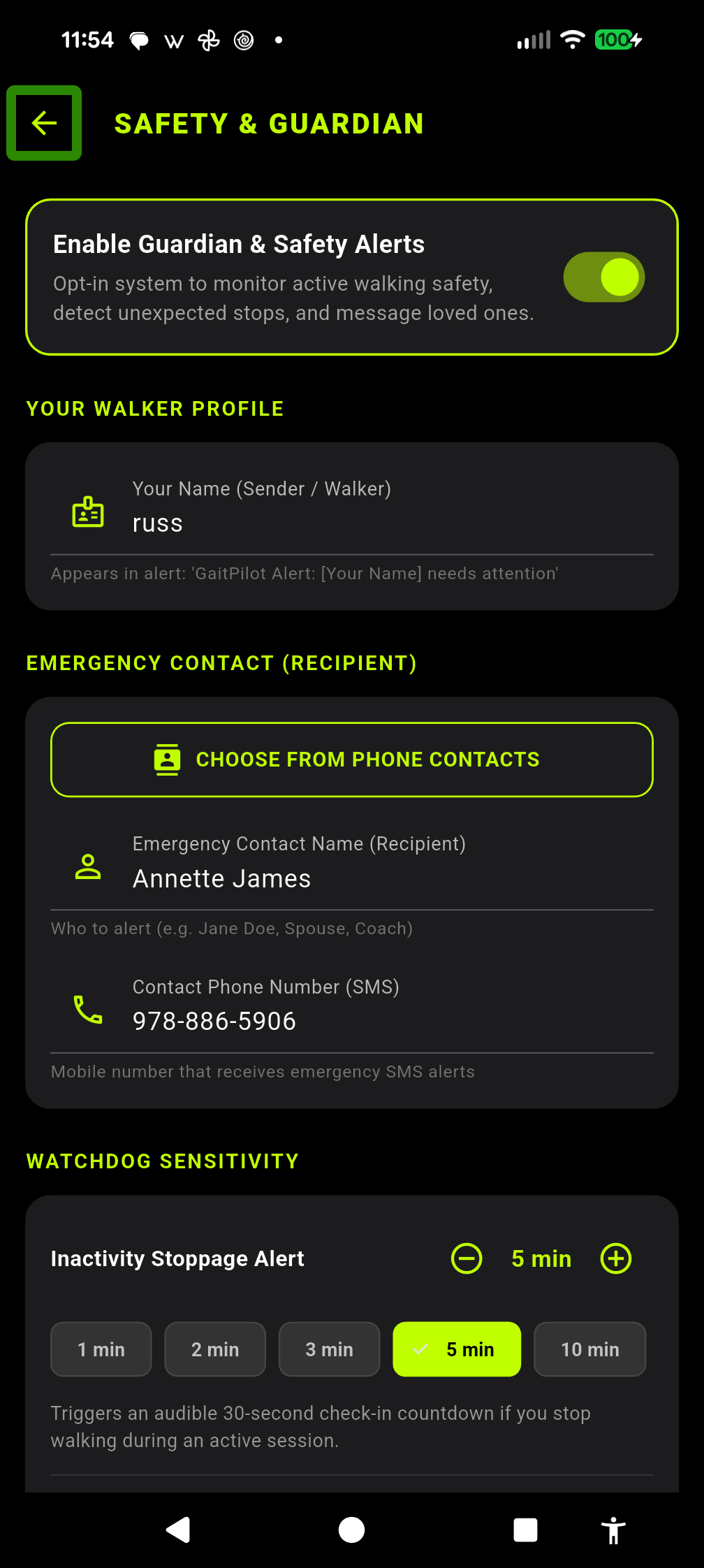
GaitPilot includes a dedicated Walker Safety & Guardian Suite designed to keep athletes and walkers safe during active outdoor or indoor workouts.
1. Core Privacy & Autonomy Mandate
- Strictly Opt-In: All safety monitoring and alerts are disabled by default. You must explicitly enable them in Settings -> SAFETY & GUARDIAN CONFIGURATION (or by tapping the Shield Icon on the top AppBar) and designate a trusted contact.
- Personal Messaging Only: All emergency notifications and live links are sent directly to your chosen emergency contact via standard text messaging (SMS). GaitPilot never makes automated phone calls or dials 911.
- Automatic Device Battery Reporting: All emergency dispatches and session-start live link messages automatically include your current phone battery level (e.g.
Phone Battery: 88%) so your guardian knows your device state.
2. Guardian Session Start & Live Route Breadcrumb Sharing
- Automated Single-Link Session SMS: When Guardian Mode is enabled, starting a walk triggers an automated SMS to your emergency contact with a single, clear, uncluttered link directly to the interactive Guardian Dashboard:
"GaitPilot: Jane Doe has started a walk.
Phone Battery: 88%
Track live on Guardian Dashboard:
https://gaitpilot.com/live?session=session-12345" - In-Dashboard Google Maps Navigation: Guardians viewing the dashboard have a prominent "Open Google Maps Navigation" button right above the vitals to launch turn-by-turn driving or walking directions to your exact location with one touch.
- Real-Time Route Breadcrumbs: As you walk, the app continuously streams your GPS coordinates to the cloud backend. When your guardian opens the web link, they see your moving pin and the complete breadcrumb path traced across the map in real time.
- Two-Way Voice Messaging & Hands-Free Reply: When your coach or guardian sends a chat message, any ongoing metric announcement is immediately silenced. The app announces: "Coach says: [message]. Say your reply now." or "Guardian says: [message]. Say your reply now." An isolated 4-second listening window captures your spoken answer and routes it back strictly to the originating channel without triggering walk navigation voice commands. Coach cues and guardian check-ins are strictly separated into isolated channels.
3. Pre-Alarm Grace Period, Native Siren & Eyes-Free Belt Dismissal
Whenever the watchdog detects prolonged inactivity, potential distress, or an impact fall:
* Internal Phone Fall & Drop Detection: Even if you walk without external sensors (carrying the phone in your hand, pocket, or belt), the phone's internal accelerometer continuously monitors for severe deceleration impacts ($>2.4\text{G}$). If an impact is followed by 5 seconds of stillness, the 30-second pre-alert immediately triggers.
* Loud Native Alarm Siren (STREAM_ALARM): The phone sounds a loud, pulsing hardware emergency siren every 1.2 seconds directly through Android's dedicated Alarm channel at 100% volume, ensuring it is audible even if your media volume is low or your phone is set to vibrate.
* Voice Countdown Guidance: Alongside the siren, the coach announces: "Safety Alert: [Reason]. 30 seconds remaining before Emergency Contact is notified. Tap screen or press volume key to cancel."
* Emergency Dispatch Tone: If the 30-second countdown expires without dismissal, the siren cuts off and a distinctive double-beep confirmation tone sounds as the emergency SMS is dispatched to your guardian.
* Eyes-Free Dismissal (Sacrum Belt or Pocket): If your phone is in a belt or pocket, you never need to pull it out. Simply press either physical volume key once (or click your wired earbud inline button) to immediately silence the siren and cancel the alert ("Safety alert cancelled. You are safe.").
* Voice Command Dismissal: You can also double-click your headset button and say "I'm okay", "Cancel alert", or "Dismiss".
4. Hands-Free Voice Emergency SOS
- Voice SOS Trigger: Double-click your wired earbud inline button (or physical volume key) and say "SOS", "Emergency", or "Help me".
- Auditory Confirmation: The app speaks: "Emergency SOS alert triggered. Sending help message in thirty seconds. Click headset button to cancel."
- Wrist SOS: On Wear OS, tap the large red Emergency SOS button on your watch screen.
5. Tiered Biomechanical Watchdog
- Phone-Only Baseline: Monitors for unexpected stoppages ($0.0\text{ MPH}$ and $0\text{ SPM}$) during an active tracking session.
- External Sensor Fusion: If external WT901BLE sensors or BLE heart rate monitors are actively streaming, the watchdog automatically fuses multi-point impact spikes and heart rate distress indicators.
- Graceful Degradation: If an external sensor disconnects or runs out of battery, the safety watchdog seamlessly falls back to phone GPS without missing a beat or throwing false alarms.
6. Two-Tier Context-Aware Protection (Auto-Track vs. Manual Walks)
- Physical Trauma & Falls (100% Protected 24/7): High-G impact falls ($>2.5\text{G}$) and cardiac distress ($>165\text{ BPM}$ tachycardia or $<40\text{ BPM}$ severe bradycardia under stillness) immediately trigger the 30-second pre-alarm and emergency SMS across all sessions, including auto-tracked background walks.
- Context-Aware Stillness & Stoppage Gating:
- Manual Outdoor Sessions: Triggers the 30-second pre-alarm after your chosen inactivity threshold (e.g. 2 minutes) under the assumption you are out on a designated route.
- Auto-Tracked Daily Walks (
AUTO-MANAGE SESSION):- Background Activation: When enabled in Settings -> POCKET MODE & AUTOMATION, the DSP engine detects sustained rhythmic steps in your pocket and launches background session recording without requiring phone unlock or screen interaction.
- Zero False Alarms on Rest: Sustained stillness quietly and automatically concludes and saves the walk with a subtle voice prompt ("Walk auto-finished due to inactivity"), completely preventing false alarms when you sit down at your desk, arrive home, or step into a car.
- Non-Intrusive Edge-First Lifecycle: Auto-tracked walks finalize kinematics, commit to the local SQLite database, and queue for cloud sync quietly in the background without throwing you into the full-screen Session Summary modal. You can review the completed workout at your convenience in Past Summaries.
7. Skin Contact & Off-Wrist Safety Protection
- Taking Off Your Watch or Whoop: If you remove your Pixel Watch or Whoop strap (e.g., to charge it or wash your hands), the sensors transmit a hardware-level "No Contact" / "Off-Wrist" flag while remaining connected over Bluetooth.
- Automatic Disarming: GaitPilot immediately recognizes that the device is off your body, displays
*** (Off Wrist)on the dashboard, and automatically disarms the cardiac distress emergency triggers. - Zero False Alarms: Placing your wearable on a table or charging dock will never trigger a false cardiac alarm or send an accidental emergency text to your contacts.
8. Test & Demonstration Mode & Sharing the Guide with Guardians
- Verification & Training: Before your first walk, you can verify your complete setup in Settings -> SAFETY & GUARDIAN CONFIGURATION -> TEST & DEMONSTRATION.
- Simulated Pre-Alarm Demonstration: Tapping "RUN 30s PRE-ALARM DEMO" triggers a simulated emergency countdown with audio warnings. If allowed to finish (or if you tap "SEND ALERT NOW"), it dispatches a clearly marked sample SMS (
[DEMO TEST]) containing your live GPS coordinates, heart rate, and phone battery percentage so your guardian sees exactly what to expect. - One-Tap Guide Sharing: Tapping "SHARE GUARDIAN GUIDE LINK" lets you instantly text or email your prospective guardian a direct link to the GaitPilot Guardian Guide to walk them through how the live breadcrumbs, navigation, and alerts work.
9. Two-Way Voice Messaging & Hands-Free Reply: When your coach or guardian sends a chat message, any ongoing metric announcement is immediately silenced. The app speaks: "Coach says: [message]. Say your reply now." or "Guardian says: [message]. Say your reply now.". An isolated 4-second listening window captures your spoken answer and routes it back strictly to the originating channel without triggering walk navigation voice commands.
- Dual-Channel Isolation: Coach biomechanical cues and guardian safety check-ins are strictly partitioned. Guardians never receive or view coach cues, and coaches never receive guardian messages.
- Session Report Insights Tab: Every incoming prompt and outgoing voice reply is logged in the session report under
-- Coach Communications --and-- Guardian Communications --, rendered with distinct visual badges in the Insights tab. - Spoken In-Ear Notifications: When your coach or guardian sends a message from their browser dashboard, GaitPilot ducks any active audio pacing or metronome and announces the message through your earbuds: "Coach says: [message]. Say your reply now." or "Guardian says: [message]. Say your reply now.".
- Hands-Free Speech Recognition: Immediately after the message is spoken, the app sounds a gentle chime and listens for 4 seconds. You speak your reply aloud without touching your phone or removing it from your waist belt.
- Instant Relay: Your transcribed response is securely dispatched back to your guardian's web dashboard chat log in real time.
10. Privacy Autonomy & Granular Metric Sharing
- Athlete-Controlled Visibility: In Settings -> METRIC CONFIGURATION, each individual metric card includes an independent Share with Guardian toggle (
isShared). - Selective Transmission: You choose exactly which telemetry channels are broadcast to the cloud relay (e.g., share Speed, Cadence, and Heart Rate, while keeping advanced biomechanical angles private). Metrics with sharing disabled are stripped at the edge on your device.
11. Radio Duty-Cycle & Adaptive Battery Conservation
- Active Movement: Telemetry streams efficiently at 5-second intervals during walking, keeping cellular radio wakeups low while maintaining smooth location tracking.
- Low-Battery Throttle (<15%): When your phone battery drops below 15%, the broadcast interval automatically throttles to 60 seconds to conserve critical power for emergency alerts.
- Stationary Deep Sleep: If you remain stationary (0.0 MPH and 0 SPM) for over 1 hour, broadcasting enters deep sleep mode to prevent battery drain if you forget to finish your session.
📋 Post-Workout Session Reporting & Safety Audit
When a workout ends, GaitPilot immediately compiles an exhaustive, accessible Session Report across three dedicated tabs:
* Summary Tab: Features high-level session cards (Symmetry Score, Average Cadence, Active Energy Burn, Elevation Gain), overall performance stats, dynamic environmental readings, and a dedicated Safety & Guardian overview detailing Guardian Master status, Live Sharing, Inactivity Watchdogs, and TV Companion pairing.
* Metrics Tab: Full dynamic foot cluster analytics (Neutral, Pronation, and Supination step counts, bilateral Planted Angles, Foot Progression Angle, Ground Contact Time, Impact Deceleration G, Lift-Off Pitch, and Push-Off Angular Velocity in °/s), bilateral foot slap counts, forward/backward arm swing arcs, and dog walking leash suppression status.
* Insights Tab: Real-time form violations and audio coaching history chronologically integrated with all Session Safety Events (pre-alerts, user dismissals, and SOS/emergency triggers). If zero issues occurred, displays an encouraging clean gait and safe walk confirmation.
* Robust File-Based Sharing: Session reports are exported as complete .txt files shared via standard Android system intents, eliminating legacy 1MB text buffer caps and allowing physical therapists, coaches, and guardians to review every stride and safety event without truncation.
🧪 Research Walking Mode (Flight Recorder) & Offline Hardware Roadmap
GaitPilot includes a specialized Research Walking Mode designed to act as a high-fidelity biomechanical flight recorder. This mode is specifically built for sports coaches, researchers, and athletes who want to record pure, uninhibited motion data across diverse physical activities without introducing coaching observer bias.
1. Purpose & Silent Observation Architecture
- Eliminating the Hawthorne Effect: When an app continuously speaks verbal advice or sounds metronomic tones, athletes unconsciously adjust their cadence, stride length, and posture. Research Mode enforces Silent Observation:
- Silences all automated spoken coaching advice, form corrections, and arm swing nudges.
- Mutes periodic interval progress announcements (e.g. elapsed time/mileage).
- Deactivates ambient posture drones and cadence metronome pulses.
- Suppresses metabolic hydration voice reminders.
- Safety Retained: Critical emergency voice actions (such as double-clicking a Bluetooth headset button to trigger an Emergency SOS or inquiring about current speed) remain fully armed.
- Full 100 Hz Deterministic Logging: While the audio remains completely quiet, GaitPilot's compiled Rust DSP engine captures every single foot strike, heel roll angle, impact deceleration ($G$), ground contact time, pelvic oscillation, heart rate, and GPS course coordinate at 100 Hz precision.
2. Interactive Activity Tagging Dialog
- When cycling through the Walking Mode selector and landing on
RESEARCH, an accessible modal dialog captures screen reader focus: - Prompts you to enter an Activity Tag describing the session (for example: Trail Run, Sprint Drills, Golf Swing, Bowling, Baseline Race Walk).
- Accidental Selection Prevention: If selected by accident, tapping CANCEL dismisses the dialog and keeps your previous walking mode active, ensuring you never inadvertently silence your everyday walks.
- Tapping CONFIRM saves your custom tag, updates the Walking Mode button to display
RESEARCH: <TAG>, and announces activation. - Quick Re-Tagging: You can long-press the Walking Mode button at any time while in Research mode to reopen the dialog and update your activity tag immediately without cycling through other profiles.
3. Forensic Session Summary & Export Badging
- Upon finishing your workout, the Session Report Summary Tab displays a dedicated high-contrast RESEARCH FLIGHT RECORDER banner highlighting your custom activity tag and noting that silent observation mode was active.
- All generated
.txtexport files record your activity tag in the configuration snapshot (Walking Mode: Research Flight Recorder (<TAG>)), providing an unalterable audit log for clinical study records and backend DSP model training.
4. Future Offline Sensor Support Roadmap (WT901 SD-CL Hardware)
- Sanctioned Competition & Wilderness Trail Readiness: In sanctioned World Athletics Rule 54.2 race walking competitions, all live wireless electronic telemetry transmission is prohibited. In addition, long wilderness trail runs frequently face severe Bluetooth connection interference or battery limitations.
- Dual-Mode MicroSD Logging: Athletes will be able to arm dual-mode WT901 SD-CL sensors using the mobile app over Bluetooth 5.0 before the event. When tapping Start, the app instructs the sensors to begin high-speed offline flash logging (up to 200 Hz) and command the Bluetooth radio to shut down for zero-RF compliance.
- Host Smartphone Sync: During the activity, the smartphone worn horizontally against the sacrum silently logs internal sacrum kinematics, GPS course tracking, and optical heart rate.
- Direct-on-Phone Ingestion via Local Rust DSP: Post-race, the athlete connects their sensors to their phone (via USB-C, OTG, or MicroSD card reader). The phone ingests the raw flash data directly and executes batch kinematic analysis through the embedded Rust DSP core in under 3 seconds. The offline foot/wrist trajectories are automatically synchronized with the phone's GPS track and heart rate history into a unified forensic report—entirely on the phone, with zero need for a laptop or cloud server.
5. Feature Availability Notice
- Current Access: Research Mode is currently unlocked across all subscription tiers for internal testers and researchers.
- Future Commercial Packaging: In subsequent public production releases, Research Flight Recorder Mode, custom activity labeling, and offline MicroSD ingestion pipelines may transition into a specialized Researcher / Coach Pro feature tier or add-on package to keep the core consumer experience streamlined for daily fitness walkers.
☁️ Cloud Sync, Data Backups & Multi-Device Restoration
GaitPilot is engineered around an Edge-First, Zero-Data-Loss Architecture. Your workouts, shoe mileage, and physical settings are protected at every level.
1. 100% Offline Local Sandbox
- All telemetry data, past session summaries, and Shoe Vault records are saved immediately to your smartphone's secure internal database.
- You can walk anywhere—in remote wilderness trails, underground tunnels, or airplane mode—and your complete biomechanics will be recorded and analyzed with zero internet connection.
2. Selective Android Cloud Backup & Device Migration
- Selective Google Drive Auto Backup (Android 12+
data_extraction_rules.xml& Android 11backup_rules.xml): Android automatically includes user preferences (SharedPreferencesfor shoe collections, speech pacing, activity profile configs, and calibration matrices) and local session databases in your Google Account's encrypted device backup (Google One / Google Drive). - Security & Privacy Exclusions: Internal application caches, temporary files, and raw debug logs are automatically excluded to preserve storage space and protect privacy.
- Seamless Device Migration: Supports full device-to-device data migration (Wi-Fi or USB-C transfer cable) during new phone setup.
- Non-Standalone Wear OS Architecture: The Wear OS companion micro-app operates as a mirrored client (
standalone=false) and receives its live state directly from the paired phone via Google Play Services Wearable Data Layer.
3. In-App Profile JSON Export & Import (Manual Backup)
- Export Configuration: In the External Sensors & Settings Hub, athletes can generate and export a complete
gaitpilot_profile.jsonbackup containing all shoe vault mileage, custom pacing configurations, and calibration matrices. - Import Configuration: Restores full app state on any compatible Android device via the native file picker without requiring cloud authentication.
- Firebase Cloud Sync: When connected to Wi-Fi or cellular data, session reports and shoe wear metrics synchronize securely to your private cloud account.
4. Using GaitPilot Across Multiple Devices
- Single Account on All Your Android Devices: Under Google Play Store licensing, you can install and use GaitPilot across all your personal Android phones, tablets, and Wear OS watches associated with your Google account at no additional charge.
- Synchronized Footwear & Sessions: Completed workouts and shoe mileage logged from your phone are visible when opening the app on your tablet.
🔒 Privacy, Security & Data Isolation
1. Strict Multi-Tenant Data Isolation
- Your biomechanical data, heart rate streams, location history, and emergency contact lists are strictly linked to your unique cryptographic user ID (
userId). - No other user or third party can access, view, or modify your records.
2. Google Play Family Library & Subscription Guidelines
- Free Tier & App Access: Available freely across all devices and eligible family members.
- In-App Subscriptions (e.g., Sonify Suite, Dog Walking Pro, Multi-Sensor Arrays): In accordance with Google Play Store policies, recurring subscriptions are strictly tied to the purchasing individual's Google Account and cannot be shared across Google Play Family Groups. Each household member desiring individual advanced biomechanical analytics maintains their own subscription.
- Clinic & Coaching Licenses: Multi-patient practice management and team coaching portals are available under dedicated organizational licensing.